A German student visa rejection after you already have a university admission letter feels like a different kind of setback than a rejected application — the hard part (getting in) is done, and now a single letter is standing between you and your flight. Most rejections at this stage are recoverable, but only if you understand exactly what your rejection notice says, what recourse actually exists in 2026, and how to rebuild your file before your intake closes.
💡 Just received a rejection letter? Don't reapply blindly — get your file reviewed first. Message Ankit on WhatsApp for a same-week review of what went wrong and what to fix.
Last reviewed: 7 July 2026. This article reflects the Federal Foreign Office's worldwide abolition of the remonstration procedure from 1 July 2025, and the German Missions in India's national visa guidance on rejected applications. Your own rejection letter is the final word on what recourse applies to your specific case — always read it in full before deciding your next step.
What Does a German Visa Rejection Notice Actually Say?
A national (long-stay, category D) student visa rejection is a formal written decision (Ablehnungsbescheid), not a vague "no." By law, it has to state the reason your application was refused, and the German Missions in India are explicit that the visa section will not give you additional explanations beyond what is already written in the letter — so read it slowly, more than once, before you email anyone.
Underneath the specific wording, most refusals for study visas trace back to one (or more) of the general conditions in Section 5 of the Residence Act (Aufenthaltsgesetz) that apply to almost every German residence title:
- Secured subsistence — the visa officer wasn't satisfied your blocked account, scholarship, or sponsor letter actually covers your living costs.
- Established identity and passport validity — a passport issue, a name mismatch across documents, or unclear identity documents.
- No public interest in refusing entry — this is the category that covers suspected fraud, prior visa violations, or inconsistent statements, and it is far more serious than a paperwork gap (more on this below).
- Programme-specific requirements — for students, this is where APS status, language proof, and the university admission letter itself get checked.
Your letter will point at the specific requirement(s) it found unmet. If your rejection letter is vague or you genuinely can't map it to a concrete document problem, that's a reason to get a second pair of eyes on your file rather than guessing — a consultant or the university's international office has usually seen the same wording before and can tell you what it typically means in practice.
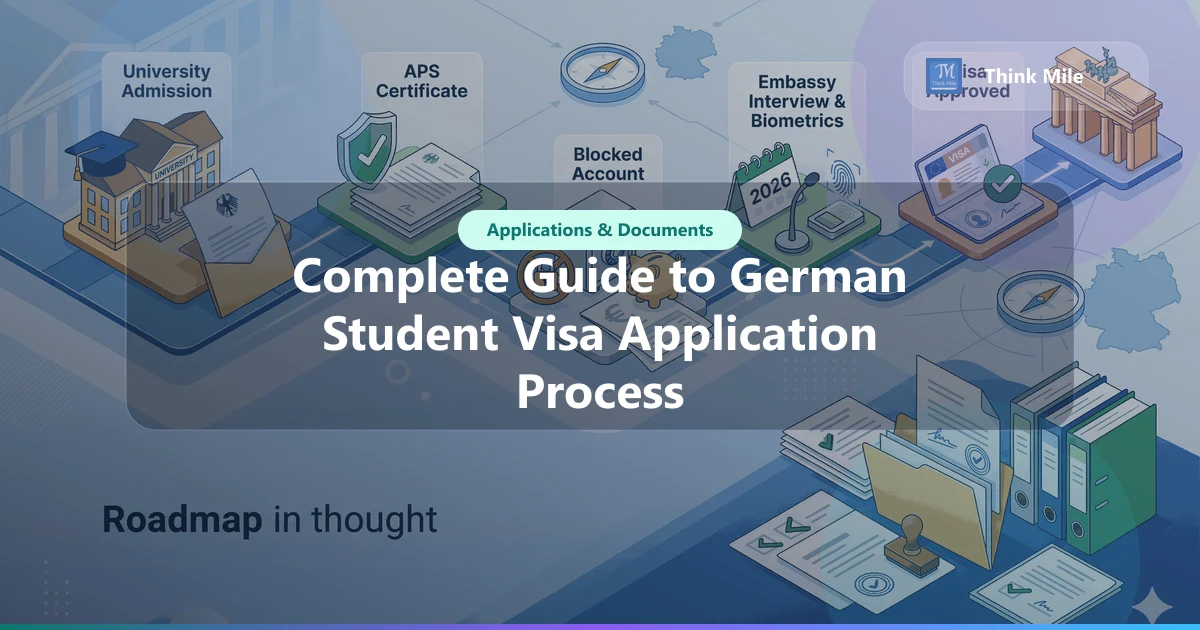
If you haven't already, it's worth re-reading the Complete Guide to the German Student Visa Application Process — its "Top 5 Reasons German Student Visas Are Rejected" section covers prevention. This article picks up exactly where that one stops: what to do once the rejection has already happened.
This is the part where a lot of outdated advice online will send you in the wrong direction, so it's worth being precise.
Until a few years ago, German visa applicants had access to a remonstration (Remonstrationsverfahren) — an informal, low-cost complaint you could file with the same visa section asking them to reconsider, before ever going near a court. It was never a legal right; the Federal Foreign Office offered it voluntarily.
Two changes matter for Indian applicants specifically:
- India first. Remonstration was discontinued for national and Schengen visa applications at German missions in India from 1 January 2024 — well ahead of the global rollout.
- Then worldwide. The Federal Foreign Office made the same change permanent everywhere from 1 July 2025, pointing to freed-up staff capacity to process more visa applications — a result first seen in a pilot that had tested suspending remonstration at a number of German visa sections starting 1 June 2023 (official announcements don't specify which missions took part in that initial pilot).
Practically, this means that by 2026 there is no remonstration option left for a rejected German student visa, whether you apply through India or anywhere else — this has already been the case for India specifically since January 2024, and is now confirmed as the permanent, worldwide policy. Do not spend time drafting a "remonstration letter" to the visa section; it will not be processed as one.
What's left, per the German Missions in India's own guidance on national visa rejections, are exactly two options:
- Submit a new visa application at any time. This is reviewed independently of the earlier rejection — there is no formal waiting period.
- File a lawsuit against the rejection with the Administrative Court in Berlin (Verwaltungsgericht Berlin), in German, within one month of receiving the rejection letter, and subject to court fees.
For almost every Indian student with an intake to hit, reapplication — not litigation — is the realistic path. A Berlin administrative court case is a genuine legal remedy and judicial review is explicitly preserved even after the remonstration abolition, but court proceedings are not built for speed. Treat a lawsuit as something to discuss with an immigration lawyer if you believe the refusal was wrong on the law (for example, a documented case of the visa section misapplying a rule), not as your Plan A when a semester start is a few months away.
💡 Not sure whether your rejection reason is fixable or worth contesting? Ask Ankit on WhatsApp — most cases are a reapplication fix, and it helps to know which kind of case you have before you spend weeks on the wrong option.
The Most Common Rejection Reasons — And Exactly What Changes in Round Two
A rejection isn't the end of the story if the underlying problem is fixable. Here's how each of the common reasons from the visa application guide actually plays out at the recovery stage.
Blocked account was incomplete, wrong provider, or missing the monthly release structure
If your blocked account didn't show the full €11,904 deposit, or was set up with a provider or structure the visa section doesn't recognise, the fix is usually mechanical: open or top up an account with an embassy-recognised provider (Expatrio, Fintiba, or Coracle), confirm the monthly withdrawal cap is correctly set at €992, and get fresh proof-of-funds documentation before you reapply. Compare providers and structures in the Blocked Account Comparison: Expatrio vs Fintiba vs Coracle, or use the Blocked Account Advisor to check your setup before you submit again. Don't just resubmit your old confirmation letter — providers date-stamp these, and a visa officer reviewing a second application will notice a proof-of-funds letter that predates your first (rejected) attempt.
The blocked account balance was correct, but the source of the money wasn't
This is a different problem from the one above, and it's easy to miss because the number on the confirmation letter looks fine. The visa section is entitled to check where the funds came from, not just the total — a large, sudden deposit shortly before your application, or a sponsor's bank statement that doesn't line up with their declared income or ITR, can fail the same "secured subsistence" ground as an account that's simply short on money. If a parent or relative is funding your account, keep the paper trail ready: salary slips, ITR, or a property-sale deed for anything unusual, even though no checklist explicitly asks for it upfront. Two related traps worth knowing about by name: the Indian Affidavit of Support, which families often assume works the same way it does for other countries' visas, is not accepted as a substitute for a blocked account or an official sponsorship letter for a German student visa; and a Verpflichtungserklärung (a sponsor's formal letter of commitment, filed in Germany) is not accepted at every mission or for every sponsor's financial profile — confirm it's viable for your specific case before relying on one instead of a blocked account.
APS certificate was missing, expired its usefulness for a changed programme, or didn't match your application
APS certificates themselves don't expire once issued, so this reason is less common at round two — but it does happen when a student changes programme or university between attempts and the APS data sheet no longer lines up with what the new admission letter states, or when the certificate was never obtained in the first place. If APS is genuinely the gap, this is the one item in this list you can't shortcut: budget the full 8–12 weeks APS India needs, and see the Complete APS Guide for Indian Students for the current process.
Cover letter or interview answers made your study plan look unconvincing
If the rejection reads like the visa officer wasn't convinced your course choice, career logic, or return-to-India intentions were genuine, don't just tweak a few sentences in the same letter — rewrite it. Explain concretely why this specific programme, at this specific university, fits your specific academic and career background, and be ready to say the same thing out loud at the appointment in your own words, not as something memorised. Use the Visa Letter Generator to structure a stronger version, and if your rejection followed an interview where you struggled with the standard embassy questions, work through likely questions and answers in the Germany Student Visa Interview Questions and Answers 2026 guide or practice with the AI Visa Interview Bot before your next appointment.
Your programme choice didn't connect to your academic or work background
This is a specific, common version of "unconvincing study plan" that deserves its own fix, because rewriting the same letter with nicer sentences won't solve it. If your admitted programme is a clear departure from your Bachelor's field — commerce into data science, mechanical engineering into an MBA, biology into computer science — a visa officer reading the file cold has no reason on paper to see the switch as anything other than a route into Germany, even when your motivation is completely genuine. An unexplained multi-year gap between your last academic activity and this application raises the same question. Neither is disqualifying, but neither is self-explanatory either: your cover letter needs to make the bridge explicit — relevant work experience, certifications, online coursework, or projects connecting your background to the new field — rather than assuming the admission letter alone proves the fit. If this is your situation, add the evidence that makes the switch look planned, not the polish.
Language proof was too old, the wrong test type, or didn't meet the programme's minimum
The German Missions India checklist wants current language proof — not older than a year, unless your admission letter already confirms sufficient proficiency — and Academic vs General IELTS is a common mix-up. If this was your rejection reason, retest if your score genuinely falls short, or simply get a fresh certificate if the issue was only that your existing one had aged out of the window. One trap catches students who think they've already covered this: a university letter confirming your programme is taught in English, or a waiver exempting you from a formal test, doesn't automatically bind the visa section — missions can and do ask for a recognised English certificate regardless of what the admission letter says. If your rejection references English proficiency despite holding a university waiver, a fresh IELTS (or equivalent) score is what closes the gap, not another copy of the waiver letter.
Document certification errors — translations, notarisation, or missing university stamps
This is one of the most fixable and most embarrassing reasons to be rejected twice, because it has nothing to do with your eligibility. Redo any translation through a certified translator, replace self-attested photocopies with properly notarised copies, and confirm every transcript carries the university's official stamp. Keep a dedicated visa-only document folder, separate from your original university-application copies, so you're not accidentally resubmitting a version the university (not the embassy) already stamped for its own purposes — the Ultimate Document Checklist covers this folder structure in detail.
Travel health insurance was missing, expired, or didn't cover the right window
The visa checklist requires incoming travel health insurance covering at least the first 90 days from your intended date of entry — separate from the German student health insurance (public or private) you enrol in after arrival for your residence permit. This is an easy thing to get wrong specifically on a second attempt: a policy bought around your first attempt's travel dates can expire, or simply no longer line up, once your appointment and entry date shift. Buy or renew the policy only after your new appointment is confirmed, and check the provider is one the mission actually recognises rather than reusing whatever a travel agent bundled in by default. See the complete guide to German health insurance for students for how the entry-period travel policy differs from your ongoing student health insurance.
A more serious finding: suspected fraud, misrepresentation, or inconsistent statements
If your rejection letter cites suspected document fraud, false statements, or contradictions between your application and your interview answers, treat this differently from everything above. This isn't a paperwork gap you can quietly correct and resubmit — it falls under the "public interest" ground in Section 5 of the Residence Act, and it can follow you into future visa applications, not just to Germany. This category also covers something that feels less like fraud and more like an oversight: not disclosing a prior visa refusal (from Germany or elsewhere in the Schengen area) or a past Schengen overstay on your application form. Leaving it out because you assumed it was irrelevant to a different visa type can still read as a false statement once the visa section cross-checks your travel history — always disclose prior refusals and relevant travel history in full, even when you're confident they don't affect your case. If this applies to your case, speak to a licensed immigration lawyer before you do anything else, rather than assuming a fresh application will simply overwrite the concern.
💡 Rebuilding your file after a rejection? 500+ Indian students have gone through this process with Ankit's guidance. The Mentor Pack (₹29,999. Package validity: Package validity: One target intake or up to one year from the joining date, whichever comes first.) includes document review and unlimited visa Q&A, with a 7-day money-back guarantee. Message on WhatsApp →
What Happens to Your Blocked Account, Deposit, and Tuition After a Rejection?
This is the question that causes the most panic in the first 24 hours, so it's worth separating the facts from the fear.
Your blocked account is still your money. A visa rejection doesn't cause you to forfeit the funds sitting in a Sperrkonto — it's a special savings account in your own name, not a government fee. You can leave it open and simply generate updated proof-of-funds documentation for your next application, or close it if you're deferring to a later intake and reopen one closer to your new appointment. Either way, confirm directly with your specific provider (Expatrio, Fintiba, or Coracle) how long your current confirmation letter stays valid and whether there's any account-maintenance fee for keeping it open longer than planned — this varies by provider and isn't set by the German government, so check your own account terms rather than assuming.
University seat deposits and tuition are a university matter, not a visa matter. Most public German universities don't charge tuition (only the semester contribution, typically €150–€400), so there's often no deposit at stake at all. But if you paid a seat-confirmation deposit or a first tuition instalment — more common at private universities or certain international programmes — the refund or deferral policy is set out in your admission offer or enrolment contract, and it's governed by the university, not by the embassy. Contact the university's international office or admissions team immediately after a rejection; many universities will defer your admission to the next intake once you show them the visa rejection letter, rather than requiring you to reapply to the programme from scratch, but you have to ask — it isn't automatic.
Flights, accommodation deposits, and travel insurance are the other line items people forget about in the panic of a rejection. If you booked anything non-refundable around your original travel date, check cancellation terms before your appointment date passes, not after.
How Much Time Do You Actually Have? Racing the Intake Deadline After a Rejection
This is the edge case that determines everything else: whether a rejection is a setback or a lost year depends almost entirely on how close your intake is.
Work backward from the official processing reality. The German Missions in India state that student visa applications are forwarded to the competent Foreigners' Authority (Ausländerbehörde) in Germany and normally take six to eight weeks after submission — and that's the timeline for a clean file, not counting the weeks it takes to fix whatever caused the first rejection, or the weeks it can take to get a fresh visa appointment slot during peak booking months (June–October, for winter intake).
Add those together honestly:
Swipe horizontally to see more
If your intake is more than 3–4 months away, a same-cycle reapplication is genuinely realistic. If it's closer than that — say, a rejection in August for an October semester start — you need to have an honest conversation with your university's international office about deferring to the next intake (usually the following semester) rather than assuming you can force a visa through in a few weeks. Universities generally understand visa rejections as a routine reason for deferral requests; they're less understanding if you go quiet and simply miss your enrolment deadline without telling them. Check your specific university's deadlines for the next intake in the German University Application Deadlines 2026–27 guide, and see How to Apply to a German University from India in 2026 if a deferral isn't offered and you need to re-run part of the university application alongside the visa fix.
There's no shortcut worth taking here: rushing a second application with the same underlying gap just produces a second rejection and burns more of your runway. A one-semester delay that ends in an approved visa is a far better outcome than two rejections in one intake cycle.
Building a Genuinely Stronger Second Application
A second attempt that just resubmits the same file with the flagged item swapped out is the minimum bar. A genuinely stronger one also checks the things that don't show up in the rejection letter but quietly increase risk the second time around:
- Re-verify the visa category and jurisdiction, especially if you moved cities or your circumstances changed between attempts — applying through the wrong VFS jurisdiction or mission is its own rejection risk, unrelated to your original issue.
- Don't create a duplicate CSP or VFS registration under a different email or category "just in case" — a second, parallel registration adds confusion to the file the visa section is reviewing and is more likely to complicate or delay processing than improve your odds.
- Match every document to the current admission letter, especially if your intake or university changed between attempts — an APS certificate, blocked-account start date, or language certificate that was fine for your first (rejected) attempt can become inconsistent if your programme start date shifted.
- Prepare for the interview, not just the paperwork. A rejected first attempt is exactly the kind of situation the Visa Interview Bot and the interview questions guide are built for — visa officers do see file history, and a confident, consistent answer at the appointment matters as much as the documents in your folder.
- Keep source-of-funds paperwork ready, not just the balance. If a parent or sponsor is funding your blocked account, carry salary slips, ITR, or a clear paper trail for any large or recent deposit — a visa officer can ask where the money came from even when the total is correct.
- Re-date your travel health insurance to your new appointment, not your old one. A policy bought for your first attempt's travel dates may have lapsed or no longer align with a shifted intake — buy or renew it only once your new appointment is confirmed.
- Get a second opinion before you resubmit, ideally from someone who isn't reading your file for the first time. It's easy to be too close to your own paperwork to spot the same gap twice.
A rejection is a hard moment, but it isn't a verdict on whether you'll get to Germany — plenty of students who were rejected once have gone on to get approved the second time with a corrected file. You can read more student success stories from Think Mile's guidance.
Frequently Asked Questions (FAQ)
1. Can I still get a German student visa after being rejected once?
Yes — a rejection doesn't bar you from reapplying. The German Missions in India explicitly confirm you can submit a new visa application at any time, and it's assessed independently of the earlier decision. Most rejections come down to a fixable document or funding gap, not a permanent bar.
2. Is there still a remonstration or appeal process for German student visas in 2026?
No. Remonstration was discontinued for national and Schengen visa applications at German missions in India from 1 January 2024, and the Federal Foreign Office abolished it worldwide from 1 July 2025. Your only options after a rejection are a new application or a lawsuit at the Berlin Administrative Court within one month of the rejection letter.
3. Is it worth suing the Administrative Court in Berlin instead of reapplying?
For most students, no — a lawsuit is a genuine legal remedy but not a fast one, and it's filed in German with court fees. It's worth discussing with an immigration lawyer if you believe the refusal misapplied the law, but if your intake is close, reapplying with a corrected file is almost always the faster, more realistic route.
4. Do I lose my blocked account money if my visa is rejected?
No. The blocked account holds your own funds, not a fee paid to the embassy. You keep the account and the money; you may just need to generate a fresh proof-of-funds confirmation for your next application. Check your provider's specific terms on document validity and any account fees. If a parent or sponsor funded the account, also keep the source-of-funds paper trail (salary slips, ITR) handy — a correct balance can still be questioned if a large deposit looks unexplained. Note too that an Indian Affidavit of Support is not accepted as a substitute for a blocked account or an official sponsorship letter.
5. Will my university admission offer expire if my visa is rejected?
It depends on the university, not on the embassy. Contact your university's international office as soon as you're rejected — many will defer your admission to the next intake once you explain the situation, but you usually need to request this rather than assume it happens automatically.
6. Do I need a new APS certificate if I reapply for a visa?
Usually not — APS certificates don't expire once issued. You'd only need a new or updated APS data sheet if you changed your programme or university between attempts in a way that no longer matches your original APS certificate.
7. My rejection said my study plan didn't connect to my academic or work background — what does that mean?
Visa officers expect your Germany programme to follow logically from your Bachelor's field or work experience. If you switched fields — commerce into data science, for example — or have an unexplained multi-year gap, the fix isn't a better-written letter alone; add the evidence (relevant work experience, certifications, coursework) that shows the switch was planned rather than a workaround for entry.
8. How long does a second visa application take after a rejection?
Budget the same official processing estimate as a first application — six to eight weeks after submission — plus however long it takes you to fix the rejection reason and get a new appointment slot. Realistically, plan for 8–18 weeks from rejection to a new decision.
9. What if my rejection letter mentions suspected fraud or false information, not just missing documents?
Treat this as a different category of problem. It falls under the "public interest" grounds in German residence law and can affect future visa applications beyond just this one attempt — this includes not disclosing a prior visa refusal or Schengen overstay, even if you assumed it was irrelevant to a different application. Speak to a licensed immigration lawyer before reapplying rather than assuming a fresh submission resolves it.
10. My rejection letter doesn't clearly explain why I was refused — what should I do?
The visa section won't give additional explanations beyond the letter itself, so re-read it carefully against the official checklist first. If you still can't map it to a specific document or requirement, get a second opinion from someone who has reviewed similar rejection letters before you reapply blind.
Why Choose Think Mile?
A visa rejection is stressful precisely because it's unfamiliar — most students only go through this process once, and there's no obvious playbook for round two. Think Mile exists to close that gap.
🎓 Rejection review: We read your actual rejection letter and map it to the specific fix needed, not generic advice.
🛂 Blocked account & document rebuild: Fast, embassy-recognised setup and corrected certified translations before your next appointment.
💬 Mock interviews: Practice the exact embassy questions that may have tripped you up the first time.
📅 Timeline planning: Honest guidance on whether to push for this intake or defer to the next one.
🤝 Ongoing mentorship: Support from your second application through arrival in Germany.
Also read: Complete Guide to the German Student Visa Application Process and Blocked Account Comparison: Expatrio vs Fintiba vs Coracle for the complete picture.
💡 500+ Indian students have navigated the German student visa process with Ankit's guidance — including several who were rejected once and approved the second time. The Mentor Pack (₹29,999. Package validity: Package validity: One target intake or up to one year from the joining date, whichever comes first.) includes document review, SOP feedback, and unlimited visa Q&A. 7-day money-back guarantee. Book on WhatsApp →