Every year, thousands of Indian students walk into their German student visa appointment worried about one thing: what will they actually be asked? The honest answer is that no embassy, VFS centre, or consulate publishes an official interview question bank — what does exist is a consistent set of themes that every visa file gets checked against, whether the checking happens through a short conversation, a document review, or (for some applicants) a separate APS interview. This guide organizes 40 example preparation questions around those themes, explains what a strong answer demonstrates versus what a weak one reveals, and points you to a free tool to practice out loud before appointment day.
💡 Reading questions on a page is not the same as answering them out loud under pressure. Practice with the free AI Visa Interview Bot — it works through realistic example questions by category and gives you feedback before your actual appointment.
Last reviewed: 6 July 2026. The figures cited here — blocked account €11,904 (€992/month), student visa fee €75, APS individual-procedure fee ₹18,000, and the 140-full-day/280-half-day student work limit — are cross-checked against the German Missions in India student visa checklist, aps-india.de, VFS Global, and §16b(3) of the German Residence Act (gesetze-im-internet.de). None of these — and no part of the interview format described below — is guaranteed to stay unchanged; always confirm current details before your appointment.
Is There an Official List of German Visa Interview Questions?
No. This is worth stating plainly because a lot of content online implies otherwise. Neither the German Missions in India, VFS Global, nor the Consular Services Portal (CSP) publishes a fixed set of interview questions. What actually happens at the visa stage varies by jurisdiction, visa category, and individual case:
- Some Indian applicants describe an appointment that is almost entirely document verification and biometrics, with only two or three basic questions from the visa section — confirming the university, the programme, and the funding source.
- Others describe a longer conversation, especially if something in the file needs clarifying (a conditional admission, a gap year, a mismatch between documents).
- There is no way to predict in advance which experience you will have, and a short appointment is not a bad sign — it usually just means your file was complete and consistent.
There's also a second, distinct process that's easy to conflate with the visa appointment: the APS interview. APS (the Academic Evaluation Centre that verifies Indian academic documents before a German student visa can be issued) doesn't publish a policy on when or whether it interviews applicants — its current official checklists and notices describe document-only verification as the default procedure. Even so, some applicants — anecdotally, more often those still completing their undergraduate degree — report being called for a short conversation (commonly described as around 20 minutes) that tests whether you actually know the subjects on your transcript. If APS does contact you for this, treat it as a separate process, at a separate office, for a separate purpose than the visa appointment. If you haven't gone through APS yet, read the Complete APS Guide for Indian Students for the full interview-preparation section — the guidance there (know your final-year project, revise core subjects, don't memorise) applies just as much if APS calls you.
The questions below are illustrative preparation questions, built around the categories that a student visa file genuinely gets assessed on — because those categories map directly onto the documents the checklist actually asks for (admission letter, blocked account, APS certificate, language proof, cover letter). They are not a leaked or verbatim list from any consulate, and treating them as one is the wrong way to prepare — more on why below.
Where Interview-Style Questioning Actually Happens
Swipe horizontally to see more
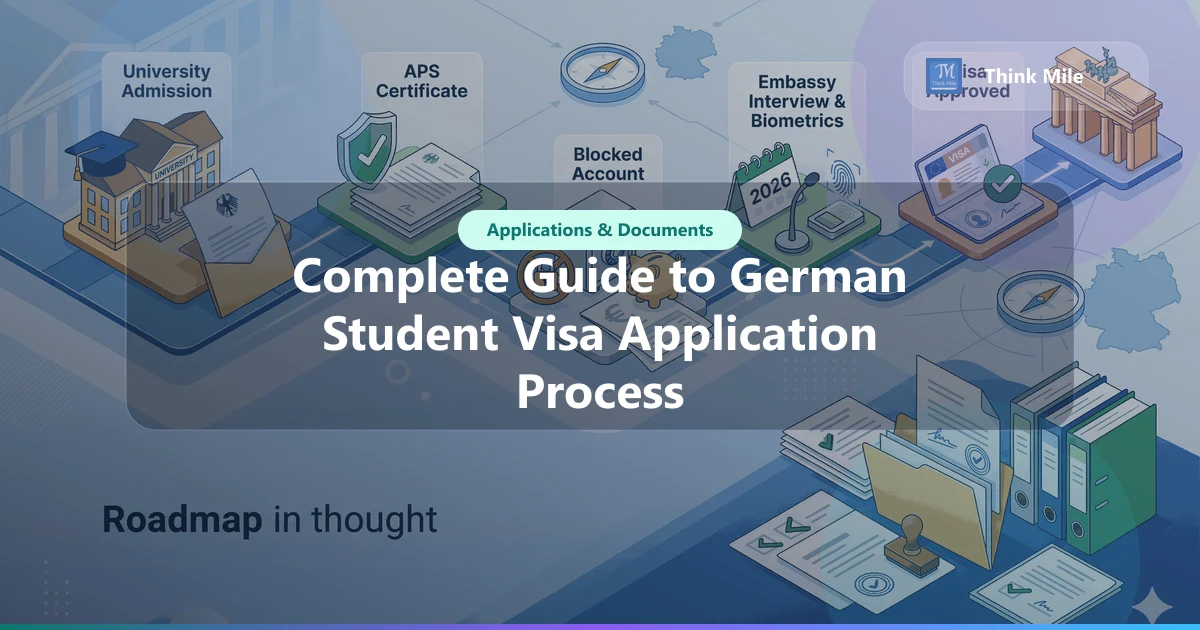
For the full visa document checklist and appointment logistics, see the Complete Guide to German Student Visa Application Process — this article assumes you've already read that and is focused specifically on the conversational/questioning part.
Quick Reference: The 5 Question Categories
Swipe horizontally to see more
Motivation and Study-Plan Questions
This category exists because the entire premise of a student visa is that you intend to study — genuinely, specifically, and at this institution. A visa officer (or, more likely, your own SOP and cover letter) is really testing whether your stated reason survives a follow-up question, not whether you can recite a rehearsed opening line.
Example questions:
- Why do you want to study in Germany specifically, rather than in India or another country?
- Why did you choose this particular university over others offering a similar programme?
- Walk me through why you chose this specific programme or course.
- What do you know about the curriculum — name a few core modules or subjects you'll study in your first year?
- Did you apply to other universities? Why is this one your first choice?
- What made you decide on this field of study at this point in your life?
- How does this programme connect to what you studied in your Bachelor's degree?
- What would you do if you didn't get into your first-choice university or programme?
What a strong answer demonstrates: specific, checkable detail — a module name, a professor's research area, a reason tied to your actual academic history, not a generic "Germany has good universities" line. It also demonstrates that your spoken answer matches what's written in your SOP and cover letter, because a mismatch between the two is exactly the kind of inconsistency that invites a follow-up question.
What a weak answer reveals: vague enthusiasm with no specific detail ("I love Germany's culture and education system"), an inability to name a single course or module, or a reason that sounds copied from a template SOP rather than connected to your actual background. If you can't explain why this university over the several others in the same field and ranking tier, that's also a signal you haven't done real comparison research — worth fixing before the appointment, not during it. The Complete Guide to Choosing the Right University for Your Profile in Germany is a useful gut-check if you can't articulate this clearly yet.
The rule behind this category, stated explicitly: the German Missions in India's own FAQ says your cover letter "has to come from your end and cannot be drafted by a third party." That's not just good advice — it's the actual reason a mismatch between your spoken answer and an agent-written or consultant-polished letter is such a specific red flag. If someone else wrote your cover letter for you, the gap between what's on paper and what you can say out loud unprompted is exactly what this category is built to surface.
If your written SOP is where this story lives, make sure it's actually strong — see How to Write a Winning SOP for German Universities and use our Visa Letter Generator to keep your spoken and written study-plan narrative aligned.
Academic Background and Consistency Questions
This category is where the visa file, your APS certificate, and your spoken answers are all supposed to tell the same story. It's less about testing subject knowledge (that's APS's job, if you're called) and more about whether your academic narrative is internally consistent and honestly explained.
Example questions:
- Tell me about your Bachelor's degree — university, subjects, and final result.
- Explain your final-year project or thesis in your own words.
- Why is there a gap between your graduation and this application?
- Do the numbers on your APS certificate and your academic transcripts match what you're telling me?
- What was your weakest subject, and how did you handle it?
- If you have a backlog or ATKT on your transcript, be ready to explain: why did it happen, and how did you clear it?
- How do you plan to manage a more rigorous German academic system given your background?
- Can you briefly explain one core concept from your major in simple terms?
What a strong answer demonstrates: comfort with your own academic record, including its weak points — a backlog explained honestly and briefly rather than glossed over, a gap year accounted for with a real (even if unremarkable) reason, and numbers that match across your CGPA, your APS documents, and what you say out loud.
What a weak answer reveals: defensiveness or evasiveness about a backlog or gap, numbers that don't add up (a CGPA stated differently than what's on your transcript), or an inability to describe your own final-year project beyond a one-line title. None of these individually sink an application, but they invite the kind of follow-up questioning nobody enjoys. If your CGPA-to-German-grade conversion is part of your confusion here, the CGPA to German GPA Conversion Guide is worth reading before your appointment so you're citing the same number your university and APS are citing.
Two harder versions of this category worth preparing for specifically, because a generic "explain your gap honestly" answer doesn't cover them: a genuine field switch (a B.Com or mechanical-engineering Bachelor's applying to an MSc in Data Science or a Master's in an unrelated field) and a multi-year gap from work, not just a delay between graduation and application. Both require more than "I explained it honestly" — they need a specific bridge: relevant certifications, projects, or work experience that make the switch or the gap look planned rather than opportunistic, not just acknowledged. A 3-year Indian Bachelor's degree is its own recurring question in this category too — be ready to explain how your specific programme's credit hours or accreditation satisfy your target university's admission requirement, since "3 years" alone sometimes triggers a follow-up about equivalence that a 4-year B.Tech graduate won't get asked.
💡 Not sure your blocked account numbers are right? Use the Blocked Account Advisor to check your provider, amount, and monthly release before anyone else does — or ask Ankit on WhatsApp if something doesn't add up.
Financial and Blocked-Account Questions
Financial questions exist because the blocked account (Sperrkonto) and sponsor documentation are the single most scrutinised part of an Indian student's visa file — and also the part where students most often let a parent or agent fill in the paperwork without understanding it themselves. That gap shows immediately in a spoken answer.
Example questions:
- How are you financing your studies and living costs in Germany?
- What is a blocked account, and how much have you deposited in yours?
- Who is your sponsor, and what is their income source?
- What would you do if your blocked account funds ran out before your programme ends?
- Do you plan to work part-time in Germany? How many days are you legally allowed to work?
- Which provider is your blocked account with, and how does the monthly release actually work?
- If your sponsor's income or savings changed, what would your backup plan be?
- Do you have any funding besides the blocked account — savings, a scholarship, or a Verpflichtungserklärung?
What a strong answer demonstrates: you personally understand your own numbers. For 2026, the standard blocked-account requirement is €11,904, released at a capped €992 per month — if you can state that (or your own account's actual figures, which should match) without hesitation, and briefly explain who your sponsor is and their income source, that's a strong signal. Knowing that non-EU students are legally capped at 140 full working days per year (with shorter shifts counted as half-days, up to roughly 280 half-days) under §16b(3) of the German Residence Act — and that part-time work is meant to supplement, not fund, your studies — also shows you understand the rules rather than assuming you'll "figure it out" after landing.
What a weak answer reveals: an inability to state your own blocked-account amount, describing your sponsor only vaguely ("my father will support me" with no income detail), or treating part-time work as your primary funding plan rather than the blocked account and family support. Compare providers before you commit to one — the Blocked Account Comparison: Expatrio vs Fintiba vs Coracle breaks down fees and processing times so you're choosing, not just accepting whatever an agent recommends.
A trap worth knowing about by name, because it catches families who've dealt with other countries' visa processes before: the Indian "Affidavit of Support" — a notarised family document commonly used elsewhere — is explicitly not accepted as a substitute for a blocked account or an official sponsorship letter (Verpflichtungserklärung) for a German student visa, per the German Missions in India's own FAQ. If question 3 or 7 above surfaces a sponsor arrangement, make sure it's an accepted document type, not an affidavit assumed to work the same way. One more detail that rarely comes up unprompted: university student-assistant work (Hiwi / wissenschaftliche Hilfskraft) doesn't count against your 140-full-day/280-half-day limit at all — if question 5 comes up, knowing this distinction (rather than just the headline day-count) signals you've actually read the rule, not just memorised the number.
Post-Study Plans and Return-Intent Questions
This is one of the more consequential categories, because a genuine study visa requires a genuine, specific study and post-study intent — vague answers here read as evasive even when the underlying intent is perfectly legitimate.
Example questions:
- What do you plan to do after you finish your degree?
- Do you intend to work in Germany after graduation? For how long?
- Why would you return to India instead of staying in Germany permanently?
- What research have you done on the job market for your field, in India or Germany?
- Do you have family responsibilities or ties waiting for you in India?
- What is the job-seeker visa, and how does it work?
- If you don't find a job in Germany after graduating, what's your plan?
- Where do you see yourself professionally five years from now?
What a strong answer demonstrates: a plan with actual structure — for example, using the 18-month post-study job-seeker period to gain relevant experience, with a specific (even if provisional) sense of what comes after, whether that's staying longer under a work permit, or returning to India with concrete reasons (family, career opportunity, a specific industry that's growing). Read the Job Seeker Visa and Finding Work After Graduation in Germany guide so you can describe this stage accurately rather than guessing at how it works.
What a weak answer reveals: either extreme is a problem — a plan so vague it sounds like you haven't thought past the admission letter, or an answer so insistent on returning to India that it sounds rehearsed rather than genuine (both come across the same way: unconvincing). The honest, useful middle ground is a plan that's specific but not overconfident: you don't need to promise permanent return with theatrical certainty, you need to sound like someone who has actually thought about what happens after graduation.
Why the over-rehearsed "I will definitely return" answer backfires, specifically: many Indian applicants over-prepare this question because they're mentally carrying over US F-1 visa instincts — the US has a formal legal doctrine (INA 214(b)) that presumes immigrant intent unless proven otherwise, which is exactly why US visa prep culture drills "prove you'll leave." Germany's student visa has no equivalent doctrine. Using the 18-month job-seeker permit, a Blue Card, or a settlement permit to stay longer is a normal, legally anticipated pathway, not a red flag to be talked around. That's precisely why an answer that oversells certainty of return reads as off — you're answering a question Germany isn't actually asking.
Red-Flag and Inconsistency Check Questions
This is the category that catches most avoidable problems, because it isn't really about any single fact — it's about whether everything you've said and submitted lines up. These are also the questions most likely to feel like "pressure," but the underlying test is simple: consistency.
Example questions:
- Your SOP describes one reason for choosing this programme, but you just gave me a different one — which is accurate?
- Have you applied for a Schengen or German visa before? Was it ever refused?
- Why does your admission letter show a different start date than what you've told me?
- You mentioned relatives or friends already in Germany — how does that factor into your plans?
- There's a large deposit in your account statement right before this application — where did that come from?
- This answer sounds rehearsed — can you explain it again in your own words?
- Given [a specific detail in your file], why should I believe you intend to study and then leave?
- If everything you've told me today were checked line-by-line against your documents, would it match exactly?
What a strong answer demonstrates: the ability to explain a discrepancy calmly and honestly rather than getting defensive or inventing a story on the spot. Most "inconsistencies" have a boring, legitimate explanation (a large deposit was your fixed deposit maturing, a date changed because the university moved the intake) — the strong move is to say so plainly, not to panic.
What a weak answer reveals: contradicting yourself further when pressed, or an answer that clearly doesn't match a document already in the file. A poorly handled inconsistency question — or a genuinely unresolved one — is one of several paths that can lead to a rejected application. If that happens to you, don't panic either: read German Visa Rejected After Admission: 2026 Next Steps Guide for what to actually do next, because a rejection is rarely the end of the road.
On question 2 specifically: the bigger risk isn't a prior visa refusal itself — it's not disclosing it. A past Schengen or German visa refusal must be declared on the application form itself, not just answered honestly if it happens to come up conversationally. Leaving it off the form because you assumed it was irrelevant to a different visa category or a different country's mission can read as a false statement once it's cross-checked, which is a materially more serious problem than the refusal itself.
How to Prepare Without Sounding Rehearsed
There's a real tension in visa preparation: you need to be ready, but memorising a script is one of the fastest ways to sound unprepared, because a scripted answer breaks the moment a follow-up question arrives that isn't in the script. A visa officer or APS interviewer doesn't need to hear polished sentences — they need to hear that you actually know your own story.
A few practical points that matter more than most students expect:
- Know your facts, not your phrasing. Understand your blocked-account amount, your programme's core modules, and your own academic gap or backlog well enough to explain them in different words each time — not as a fixed paragraph you've repeated 40 times to your mirror.
- Practice out loud, with follow-up questions. Reading a list of questions silently doesn't prepare you for the moment someone asks "why not [Y] instead" right after you answer "why [X]." This is exactly the gap our AI Visa Interview Bot is built to close — it's free, and it's a better use of an evening than re-reading this list one more time.
- Get a second pair of eyes on your written documents first. If your SOP, cover letter, and spoken answers don't already agree with each other, no amount of interview practice fixes that — fix the documents first. The Ultimate Document Checklist for Your German University Application is a good final check before you even get to interview prep.
- Don't over-rehearse the "return to India" answer specifically. Ironically, it's the one students memorise most — which is exactly why it tends to backfire. Keep it calm and specific rather than emphatic and polished.
- If you're headed to a German-taught programme or Studienkolleg, prepare for a basic question in German too. This is a distinct population from the English-taught-programme majority this guide otherwise focuses on — if your admission depends on demonstrated German ability, don't assume every question will be in English just because most of this guide's examples are.
What If You Don't Know an Answer, or You Freeze?
This happens, and it isn't the disaster it feels like in the moment. A few honest approaches work better than the alternative of guessing or inventing something:
- Pause instead of panicking. A few seconds of silence to gather your thoughts is completely normal and reads far better than a rushed, wrong answer.
- Say what you don't know, plainly. "I don't have the exact figure in front of me, but I can tell you roughly how it works" is a legitimate answer — it's the difference between honest uncertainty and evasiveness that matters, not perfection.
- Never fabricate a number or a fact. If you're unsure of your blocked account's exact monthly release figure or your university's exact module names, say so and offer what you do know. Being caught in a fabricated detail is far more damaging than an honest "I'm not certain."
- Ask for clarification if the question is unclear. It's reasonable to ask someone to repeat or rephrase a question rather than guessing at what they meant.
Does a Bad Interview Automatically Mean Rejection?
No — an awkward moment or one poorly handled question is rarely, on its own, what causes a visa rejection. Visa decisions weigh the complete file: your documents, your blocked account, your APS certificate, your admission letter, and the conversation together. The Complete Guide to German Student Visa Application Process covers the five most common actual rejection reasons in detail, and none of them is "answered one question awkwardly" — they're things like an incomplete blocked account, a missing APS certificate, or document certification errors.
That said, if your application is refused — whether the reason was interview-related or something else entirely — the right move is to figure out exactly why and address it, not to panic or assume the door is closed. Our sibling guide, German Visa Rejected After Admission: 2026 Next Steps Guide, walks through what to do in the days and weeks immediately after a rejection.
Frequently Asked Questions (FAQ)
1. Is there an official list of German student visa interview questions?
No. Neither the German Missions in India, VFS Global, nor the Consular Services Portal publishes a fixed interview question bank. The questions in this guide are illustrative examples built around the categories a visa file is genuinely assessed on — not a leaked or verbatim list.
2. Do all Indian students get interviewed at their visa appointment?
Not in a uniform way. Some applicants go through an appointment that's mostly document verification and biometrics with only a few basic questions; others describe a longer conversation. It varies by German Mission jurisdiction, visa category, and individual file. A short appointment is not, by itself, a bad sign.
3. How is the APS interview different from the visa interview?
They're separate processes run by separate organisations. APS's own checklists describe document-only verification as standard, but some applicants — anecdotally, more often those still completing an undergraduate degree — report being called for a short conversation (commonly described as around 20 minutes) testing whether they know the subjects on their transcript. The visa appointment, run by VFS or the German Mission, is focused on document verification and your overall study/financial plan. See the Complete APS Guide for APS interview preparation specifically.
4. What language is the interview conducted in?
For APS, you can typically choose English or German at registration. For the visa appointment itself, English is generally usable for Indian applicants, though this can vary by individual case — confirm with your specific German Mission or VFS centre if you're unsure.
5. Can I bring notes into the interview?
Treat any conversation as something to handle without reading from a script — an interviewer relying on written notes to answer basic questions about their own study plan doesn't read as prepared, it reads as unprepared. Know your key facts well enough to speak naturally instead.
6. What happens if I don't know an answer?
Say so honestly, and share what you do know. "I'm not certain about the exact figure, but here's roughly how it works" is a legitimate answer. Never fabricate a number or detail — being caught in a fabrication is far more damaging than an honest gap in knowledge.
7. Does a bad interview automatically mean rejection?
No. Visa decisions weigh your complete file — documents, blocked account, APS certificate, admission letter — together with any conversation. A single awkward moment rarely sinks an otherwise complete, consistent application. If you are rejected, see our next-steps guide for how to respond.
8. How should I prepare without sounding rehearsed?
Understand your facts (blocked account amount, programme modules, your own academic history) well enough to explain them in different words each time, rather than memorising a fixed script. Practice with follow-up questions, not just a static list — that's exactly what a mock interview or practice tool is for.
9. Is there a free way to practice these questions out loud?
Yes — the AI Visa Interview Bot lets you work through example questions by category and get feedback before your actual appointment, at no cost.
10. What are the current blocked account and visa fee amounts for 2026?
The blocked account requirement is €11,904 for the year, released at a capped €992/month. The German national visa fee is €75. Both are cross-checked against the German Missions in India checklist and VFS Global as of this article's last review — always confirm the current figures before your appointment, since they are set by German authorities and can change.
Why Choose Think Mile?
Ankit has personally guided 500+ Indian students through the German student visa process — including mock interview preparation, document review, and the exact kind of consistency-checking this article describes, done by a person instead of a checklist.
🎓 Full Application Support: SOPs, university shortlisting, Uni-Assist, and the complete visa document file.
🛂 Interview & Blocked Account Prep: Practice conversations plus setup guidance for Expatrio, Fintiba, or Coracle.
📋 Consistency Review: A second pair of eyes across your SOP, cover letter, and spoken study plan — before an officer finds the gap first.
🤝 Unlimited Visa Q&A: Ask anything, anytime, through the Mentor Pack.
The Mentor Pack (₹29,999. Package validity: Package validity: One target intake or up to one year from the joining date, whichever comes first.) includes SOP and LOR review, shortlist review, and unlimited visa Q&A — with a 7-day money-back guarantee, no questions asked. The Premium Package (₹80,000) covers end-to-end support with a full refund if no admission is received.
💡 Want Ankit to run a mock interview and check your file before your actual appointment? Message Ankit on WhatsApp →