Related Articles
Continue reading about Visa & Finances
Health insurance (Krankenversicherung) is mandatory in Germany — not just recommended, but legally required. Without valid health insurance, you cannot enroll at a German university or obtain a residence permit. Over 500+ Indian students we've guided to Germany have had to sort this out before anything else moved forward.
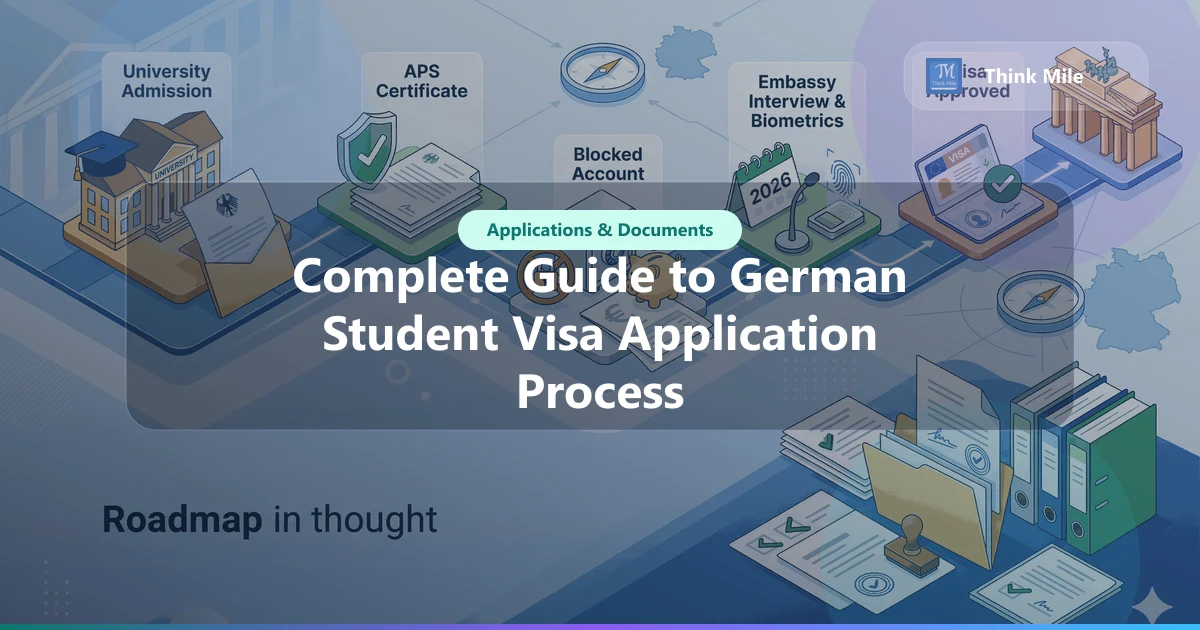
This guide explains everything you need to know about German health insurance in 2026: public contribution examples, what public vs private covers, how university enrollment proof works, and when switching makes sense. If you're preparing your visa documents, also read Complete Guide to German Student Visa Application Process for the full picture.
Last reviewed: 21 September 2026. Student statutory health-insurance contributions changed for 2026 and vary by insurer because each Krankenkasse sets its own supplementary contribution. Always verify the current contribution table with your chosen insurer and the exact health-insurance requirement on your university and German Mission/VFS checklist.
💡 Not sure where to start with Germany prep? Talk to Ankit on WhatsApp — he's helped 500+ Indian students navigate insurance, blocked accounts, and visa paperwork.
In Germany, health insurance isn't optional — it's the law.
You Need Health Insurance For:
Without It:
💡 Think Mile Tip: Getting health insurance should be one of your first steps — ideally before your visa appointment. Many blocked account providers (Expatrio, Fintiba) offer bundled health insurance packages.
Germany has a two-pillar health insurance system:
| Aspect | Public (GKV) | Private (PKV) |
|---|---|---|
| German Name | Gesetzliche Krankenversicherung | Private Krankenversicherung |
| Monthly Cost | Usually |
Varies widely by plan, age, and coverage |
| Coverage | Comprehensive, regulated by law | Varies by plan — read fine print |
| Student-rate age limit | Usually until the end of the semester in which you turn 30, with limited exceptions | No statutory student-rate age limit, but premiums and terms vary |
| Accepted For | University enrollment, visa, residence permit | Visa if equivalent; university enrollment requires exemption/insurance-status notification via a statutory insurer |
| Switching | Can switch to private later | Very difficult to switch back to public |
| Best For | Most Indian students under 30 | Students over 30, language-course students |
Swipe horizontally to see more
For Indian students on a Master's in Germany, public insurance (GKV) is usually the simplest long-term choice — it is broadly accepted for enrollment and healthcare access. The final monthly contribution differs by insurer because of supplementary contributions.
Public health insurance is the recommended choice for most international students because:
The base student contribution is regulated, but the final amount differs by public insurer because each insurer charges its own supplementary contribution. Long-term care insurance also changes by age and child status.
TK's 2026 student contribution table is a useful example:
| Component | Monthly Cost (2026) |
|---|---|
| Health insurance at TK, including TK supplementary contribution | €110.38 |
| Nursing care, under 23 or with at least 1 child | €30.78 |
| Nursing care, age 23+ with no children | €35.91 |
| Total at TK, under 23 / with child | €141.16/month |
| Total at TK, age 23+ without child | €146.29/month |
Swipe horizontally to see more
Other public insurers can be higher or lower depending on their Zusatzbeitrag. The biggest differences between TK, AOK, DAK, and Barmer are final contribution, service quality, English support, and digital features.
In INR (at ~₹93/EUR): TK's 2026 student rate is approximately ₹13,100-₹13,600/month — or ₹1.57-₹1.63 lakh/year. Budget for this as a fixed cost alongside rent and food when planning your annual Germany expenses.
Public insurance covers almost everything you'll need:
| Covered | Not Covered (Usually) |
|---|---|
| ✅ Doctor visits | ❌ Cosmetic procedures |
| ✅ Hospital stays | ❌ Most dental work (except basics) |
| ✅ Prescription medications | ❌ Glasses/contacts |
| ✅ Mental health care | ❌ Alternative medicine |
| ✅ Preventive care | ❌ Private hospital rooms |
| ✅ Maternity care | ❌ Non-prescription drugs |
| ✅ Specialist referrals | |
| ✅ Emergency care |
Swipe horizontally to see more
All public insurers follow the statutory student-insurance framework, but their final monthly contribution can differ because of the insurer-specific supplementary contribution. Differences are in price, service, and digital handling:
| Insurer | English Support | App Quality | Online Application | Best For |
|---|---|---|---|---|
| TK (Techniker Krankenkasse) | Excellent (full English site) | Best-in-class | Yes — tk.de/en | Most Indian students — top pick |
| AOK | Basic | Varies by region | Yes | Students who prefer local branch |
| DAK-Gesundheit | Moderate | Good | Yes | DAK has fast online service |
| Barmer | Moderate | Good | Yes | Reliable alternative to TK |
| IKK classic | Limited | Basic | Partial | Regional; less popular |
Swipe horizontally to see more
💡 Think Mile Tip: TK (Techniker Krankenkasse) is the top choice for Indian students — English app, English customer service hotline, and fast online enrollment at tk.de/en. If TK has a waitlist or issue, go with DAK as second choice.
Step 1: Choose an Insurer Research TK, AOK, or others. All public insurers follow the same statutory coverage framework, but the final contribution differs by Zusatzbeitrag and nursing-care category — choose based on price, service quality, and convenience.
Step 2: Apply Online Most insurers have online applications:
Step 3: Submit Required Documents
Step 4: Receive Confirmation
Step 5: Get Your Health Insurance Card (Gesundheitskarte)
💡 Confused about which insurer to pick for your visa application? Message Ankit on WhatsApp — he's guided 500+ Indian students through this exact decision and can tell you what works for your specific university and city.
Private insurance makes sense for:
Private insurance for students can cost:
⚠️ Warning: Cheap plans often have coverage gaps. Read the fine print, especially for pre-existing conditions, mental health, deductibles, maximum reimbursement, and whether the policy meets visa and university requirements.
| Risk | Explanation |
|---|---|
| Coverage gaps | Budget plans may exclude mental health, dental, or chronic conditions |
| Deductibles | Some plans require you to pay the first €250-€500/year |
| Claim process | You pay upfront, then submit claims for reimbursement |
| Pre-existing conditions | May be excluded or increase premiums |
| Switching difficulty | Changing to public insurance later is complicated |
Swipe horizontally to see more
| Provider | Starting Price | Notes |
|---|---|---|
| DR-WALTER (EDUCARE24) | ~€39/month | Popular for visa applications |
| Care Concept (Care College) | ~€35/month | Budget option |
| Mawista | ~€59/month | Good coverage |
| DAAD Insurance | ~€35/month | For scholarship holders |
Swipe horizontally to see more
💡 Think Mile Tip: Private insurance can be visa-compliant, but universities may still require you to show exemption from public insurance (Befreiung). This is a one-time declaration — be sure before you commit!
German law generally gives students access to discounted statutory student insurance until the end of the semester in which they turn 30, with limited exceptions.
After turning 30:
| Situation | Recommendation |
|---|---|
| Starting Master's at 28 | Public insurance makes sense |
| Starting Master's at 29 | Ask the insurer what happens after the semester in which you turn 30 |
| Already 30+ | Compare voluntary public insurance with private student plans |
| Language course at 31 | Private is often used, but verify visa and course requirements |
Swipe horizontally to see more
Step 1: Find a General Practitioner (Hausarzt)
Step 2: Book an Appointment
Step 3: At the Appointment
German healthcare uses a referral system:
Exception: You can go directly to:
| Situation | What To Do |
|---|---|
| Life-threatening emergency | Call 112 (ambulance) or go to Notaufnahme (ER) |
| Urgent but not emergency | Visit Bereitschaftspraxis (after-hours clinic) or call 116117 |
| Need advice | Call 116117 (24/7 medical hotline) |
| Pharmacy needed at night | Look for Notdienst Apotheke (night pharmacy) |
Swipe horizontally to see more
💡 Think Mile Tip: Save 112 (emergency) and 116117 (non-emergency medical advice) in your phone immediately after arriving.
Mental health support is included in public insurance:
What's Covered:
How to Access:
Challenge: Wait times for therapy can be 3-6 months. University psychological counseling (Psychologische Beratung) is often faster for students.
| Type | Co-Pay |
|---|---|
| Standard prescription | €5-€10 |
| Chronic illness meds | Often fully covered after threshold |
| Birth control (under 22) | Fully covered |
| Non-prescription items | Full price (not covered) |
Swipe horizontally to see more
For visa application: Some embassies accept travel insurance initially, but:
Many Indian students arrive on a private insurance plan (e.g., bundled with Expatrio/Fintiba) and want to switch to public insurance (TK/AOK) after arrival because it is simpler for enrollment and routine healthcare access.
| Situation | Can You Switch to Public? |
|---|---|
| You had private insurance and are under 30 | Yes — apply to TK/AOK within the first weeks of enrollment |
| You formally opted out of public insurance (Befreiung) | Very difficult — generally locked in until significant life change |
| You're over 30 | No — public student rate no longer available |
Swipe horizontally to see more
The key rule: If you never formally signed a Befreiung (exemption from public insurance), you can join a public insurer when you enroll. If you did sign a Befreiung, switching back is extremely restricted.
💡 Think Mile Tip: Check with your blocked account provider whether switching insurance affects any bundled coverage. Expatrio's private plan is separate from your blocked account — cancelling it won't affect your monthly transfers.
Getting your insurance card isn't automatic — here's the exact post-arrival sequence:
Register your address at the local Einwohnermeldeamt within 2 weeks of arrival. Your Steuer-ID and insurance card address depend on this.
Ask your insurer to transmit your insurance status electronically to the university. Many universities no longer accept only a membership certificate, insurance card, or PDF confirmation.
| When | Action |
|---|---|
| 3-4 months before arrival | Research public vs. private |
| 2-3 months before | Apply for insurance |
| 1-2 months before | Receive confirmation letter |
| At visa appointment | Show insurance confirmation |
| After arrival | Receive insurance card |
Swipe horizontally to see more
Many blocked account providers offer insurance packages:
| Provider | Blocked Account | Insurance Option |
|---|---|---|
| Expatrio | ✅ | Private (DR-WALTER) included |
| Fintiba | ✅ | Private (Mawista) option |
| Coracle | ✅ | Various options |
Swipe horizontally to see more
💡 Think Mile Tip: These bundles are convenient for visa applications, but you may want to switch to public insurance (TK) after arriving if you're under 30. See our Blocked Account Comparison: Expatrio vs Fintiba vs Coracle to understand what each bundle actually covers.
This is one of the most searched questions — and the answer is simple but easy to get wrong.
For your student visa appointment, the German embassy needs proof that you have health insurance coverage starting from your arrival in Germany. What they accept:
| Document | Who Issues It | Accepted? |
|---|---|---|
| Public German health insurance letter plus travel health insurance until public cover starts | TK / AOK / other public insurer + travel insurer | Usually yes; matches the German Missions India checklist structure |
| Equivalent private foreign or German health insurance | Private insurer | Possible if it meets the mission's equivalence criteria |
| Blocked account provider bundle certificate | Provider / partner insurer | Commonly used, but verify the actual insurer certificate and dates |
| Indian health insurance policy | Indian insurer | Only if it explicitly meets the German Mission's equivalence requirements |
| Generic travel insurance only | Travel insurer | Not enough for long-term study/enrollment |
Swipe horizontally to see more
The safest approach for visa: follow the current German Missions India checklist for your appointment. If you use a bundled product from Expatrio/Fintiba/Coracle, check the insurer certificate, start date, and whether it covers the period until your public German insurance begins.
After arrival: if you are under 30 and have not signed a Befreiung, ask a German public insurer to send the electronic university notification before enrollment. If you formally opt out of statutory insurance, switching back during the same course of study is usually not possible.
💡 Not sure which insurance document your specific consulate accepts? Ask Ankit on WhatsApp — requirements can vary by mission and change without notice.
1. Can I change from private to public health insurance? It's complicated. Once you opt out of public insurance (Befreiung), switching back is very difficult. You may only switch back if you start working more than 20 hours/week or if certain life circumstances change. Choose wisely initially.
2. What if I arrive before my insurance starts? Bring travel insurance for the gap period. Apply for German insurance immediately after arrival. Most insurers can backdate coverage to your entry date.
3. Do I need insurance during semester breaks? Yes. Insurance must be continuous regardless of whether classes are in session. Coverage gaps can cause problems with your residence permit.
4. How do I prove insurance for university enrollment? Ask a German statutory health insurer to send your insurance status electronically to your university. Privately insured students usually still need a statutory insurer to transmit the exemption/insurance-status notification.
5. Is dental care covered? Basic dental (check-ups, fillings) is covered. Advanced work (crowns, implants, orthodontics) usually requires additional dental insurance or high out-of-pocket costs.
6. What if I need to see a doctor and don't have my card yet? Your insurer can provide a temporary certificate or you can pay upfront and get reimbursed. In emergencies, hospitals treat you regardless.
This article was rechecked on 5 June 2026 against gesund.bund.de student health-insurance guidance, DAAD health-insurance guidance, DAAD enrollment guidance, TK 2026 student contribution table, AOK 2026 student insurance contribution overview, the German Missions India student visa checklist, and university guidance showing the electronic health-insurance notification process, including University of Potsdam, University of Regensburg, and TUM mandatory health insurance. Always verify your own university's enrollment page because the required university number and submission process vary.
💡 Need your visa finance stack checked? Health insurance, blocked account, APS, and appointment timing have to line up. The Mentor Pack includes visa Q&A and document review with Ankit.
Navigating the German health insurance system is confusing when you're simultaneously managing visa paperwork, blocked accounts, and accommodation. At Think Mile, we've helped 500+ Indian students figure out exactly which insurance to pick, when to apply, and how to make the switch after arrival.
The Mentor Pack (₹29,999. Package validity: One target intake or up to one year from the joining date, whichever comes first) includes guidance on insurance decisions as part of full Germany application support — with a 7-day money-back guarantee if it's not right for you. See our pricing for full details.
👉 Your health is your foundation. Message Ankit on WhatsApp and get a straight answer on which insurance is right for your situation — no fluff, no forms.
Free AI tools — no account needed
Think Mile's AI tools do the research work. Start with University Finder and upgrade to expert review when you're ready.
We earn nothing from universities. Ever.
Free email guide
10-step checklist + every free tool linked, delivered to your inbox.
No spam. Unsubscribe any time.
Continue reading about Visa & Finances