Related Articles
Continue reading about Success Stories
"I had already faced a visa rejection before coming to Think Mile — I wasn’t sure anyone could help me."
— Nidhi Shetty, MSc in Supply Chain Management and Logistics, Arden University
That line is where Nidhi Shetty's story with Think Mile actually starts — not with an admission letter, but with a rejection stamp already in her passport file. She later wrote a longer note about what happened next, and this article uses her own words as its anchor rather than a dramatized retelling of her case.
Here is her full note, unedited:
"Just wanted to say a huge thank you to you, Ankit! You totally turned my profile around after my previous visa rejection. You handled everything so smoothly — LOM, CSP forms, appointments, interview prep — you made it all look easy. Your service is top-notch. Highly recommend Think Mile!"
— Nidhi Shetty, Arden University ("Visa Success after Rejection")
A note on honesty before we go further. Nidhi's own words above — the rejection she'd already faced, and the thank-you note naming LOM, CSP forms, appointments, and interview prep — are the only verified facts about her case that Think Mile is publishing. We don't know, and won't invent, her specific rejection reason, which city she applied from, which embassy or VFS centre handled her file, how long her reapplication took, or what was said in her interview. Out of respect for her privacy, those details simply aren't part of this story. What follows instead is general, honestly-labelled educational content: how the German student visa rejection-and-reapplication process actually works, for any reader currently in the position Nidhi described — not sure anyone can help.
💡 Already holding a rejection letter and not sure what to do next? Message Ankit directly on WhatsApp for a free, honest read of your file — no forms, no call centre.
Last reviewed: 6 July 2026. The rejection, appeal, and reapplication rules below are cited directly from the German Missions in India (india.diplo.de) and the Federal Foreign Office (auswaertiges-amt.de). Nidhi's quotes are reproduced exactly as given and have not been edited for this piece.
A rejected national visa application doesn't disappear into a black box. According to the German Missions in India, a reason for the rejection is stated in the rejection letter itself — and the visa section will not provide any additional explanation beyond what's written there. That letter is the single most useful document a rejected applicant has, because, in the embassy's own words, "most rejections are the result of incomplete or unverifiable documentation."
That single sentence matters more than it sounds. It means the majority of rejections aren't about a fixed, unappealable judgment on a person's suitability — they're about a specific document or piece of proof that didn't hold up to scrutiny at the time of assessment. Read literally, that's also the encouraging part: a documentation problem is, by definition, fixable.
As of this writing, an applicant whose German national visa is rejected has exactly two official options:
A third option that used to exist — remonstration, a free internal request to have the mission reconsider its own decision — no longer applies. The Federal Foreign Office abolished the remonstration procedure for visa rejections worldwide from 1 July 2025. If you're reading this in 2026, remonstration is not on the table; reapplication or litigation are the only two routes.
For the fuller step-by-step breakdown of what to do in the days immediately after a rejection notice arrives, see our companion guide: German Visa Rejected After Admission: 2026 Next Steps Guide.
Every mission handles cases individually, and Think Mile has no visibility into any specific applicant's confidential file — including Nidhi's. But the German Missions in India do publish, in general terms, the areas that most commonly trip up a student visa file. Four show up repeatedly.
The visa section has to be satisfied that an applicant can finance their stay in Germany for up to a year. As of 1 September 2024, that means demonstrating access to €992 per month — the figure behind the well-known blocked-account minimum of roughly €11,904 for a full year. If a scholarship or stipend doesn't cover this in full, the shortfall has to be closed with a blocked account or an official sponsorship letter (a Verpflichtungserklärung).
The detail almost nobody flags in advance: the Indian "Affidavit of Support" — a document Indian families are used to using for other visa processes — is explicitly not accepted as a substitute for a blocked account or an official sponsorship letter for a German student visa. Families sometimes assume a notarised affidavit from a parent is equivalent proof. It isn't, and finding that out from a rejection letter rather than in advance is one of the more avoidable ways a file falls apart.
See our blocked account comparison of Expatrio, Fintiba, and Coracle for how to actually set this up, and Think Mile's Blocked Account Advisor tool if you want a quick sense-check on your own numbers.
This is one of the two terms Nidhi mentions directly — LOM, short for Letter of Motivation. Interestingly, the German Missions in India refer to this same document in their own FAQ as a "cover letter," and depending on the mission or programme, you'll also see it called a motivation letter or statement of purpose. It's the same underlying idea: a letter explaining why you want to study in Germany specifically, from your own perspective.
Two things the missions are explicit about: there is no prescribed format for this letter, and — this is the part worth sitting with — it has to come from the applicant themselves and cannot be drafted by a third party. That's a real constraint on what any consultant, including Think Mile, can properly do here: coach, structure, and review a cover letter honestly written by the student, not ghostwrite one on their behalf and hand it over as if it were the student's own words.
A related trap: many applicants reuse their university admission SOP, word-for-word, as their visa cover letter. The two documents are answering different questions for different audiences — a university wants to know why you're a fit for its programme; the visa section wants to know your motivation for studying in Germany itself. A letter that only ever talks about the programme, without addressing the "why Germany" question the visa section is actually assessing, can read as thin even when the underlying motivation is genuine.
If you want a structured starting point for that letter (while still writing it yourself), Think Mile's Visa Letter tool is built for exactly this distinction. Our pillar guide to writing a winning SOP is the right reference for the university-facing document — read both, but don't submit the same file to both audiences.
A detail that surprises a lot of applicants: the German Missions in India are explicit that a university's confirmation letter is "only sufficient if the university has individually tested your language skills and confirms the same for your case" — a generic letter stating the programme is taught in English doesn't meet that bar. The missions' own guidance goes further, warning applicants directly: do not submit exemption letters or language-of-instruction certificates in place of a recognised English certificate, because "the visa section has the right to ask for the same" regardless. Applicants who assume "my university said I don't need IELTS" is the end of the conversation sometimes discover, at the visa stage, that it isn't.
Beyond these named categories, the missions' own framing — "incomplete or unverifiable documentation" — is broad enough to cover missing academic transcripts, an APS certificate that isn't yet valid or on file, inconsistent dates between documents, or a document that simply couldn't be confirmed as genuine in the time available. Our document checklist guide and complete APS guide both cover this ground in more depth — APS in particular is a prerequisite most Indian applicants can't skip, and a file that's otherwise strong can still stall if the APS certificate isn't properly in place.
It's worth pausing on the second acronym in her note, because it's less commonly explained than LOM.
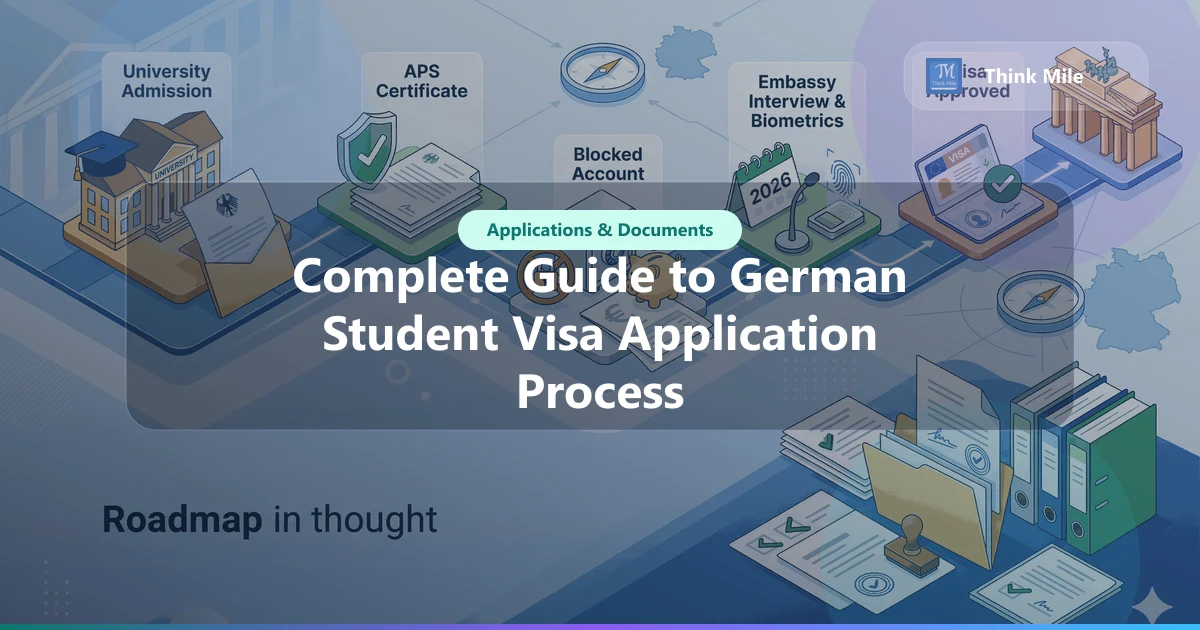
CSP stands for the Consular Services Portal, the German government's own online platform at digital.diplo.de for visa-related services provided by German missions abroad. For applicants in India and a handful of other countries, the student-visa category can now be applied for and pre-checked through this portal before the in-person appointment stage — a shift from the older process, which ran entirely through appointment booking and paper submission. It sits alongside VFS Global, which typically still handles biometrics and, depending on the mission and category, appointment booking. Our complete guide to the German student visa application process walks through how CSP and VFS fit together end-to-end.
Read together, "LOM, CSP forms, appointments, interview prep" — the exact phrase Nidhi used — maps onto four genuinely distinct parts of a visa file: the personal letter only the applicant can write, the online portal submission, the in-person or biometric appointment, and the interview itself. A consultant's actual job across all four is coordination and preparation, not doing any of it for the applicant in a way that would misrepresent whose file it is.
To be clear: this section is general guidance for any reader in a similar position, not additional detail about Nidhi's specific case — we don't know the specifics of what changed in hers, and we're not going to guess.
Legally, a reapplication isn't an appeal. It's a fresh visa application, assessed on its own merits, not a request to revisit the previous decision (that's what the now-discontinued remonstration procedure, and the Berlin lawsuit route, were for). That has a practical consequence: a reapplication needs to stand on its own as a complete, internally consistent file — it isn't reviewed as "the same case, corrected," even if in practice the same underlying documents carry over.
In practice, most people preparing a genuine reapplication find themselves doing some version of the following, directly informed by the one piece of information they do have — their own rejection letter:
The upside, worth repeating because it's easy to miss under stress: there is no cooling-off period. A rejected applicant can start preparing a stronger reapplication the same week, rather than waiting out an arbitrary delay.
💡 Preparing for a visa interview after a previous rejection? Practice with Think Mile's Visa Interview Bot — free, and built around the questions that actually come up.
Being allowed to reapply immediately isn't the same as it being wise to. A file resubmitted in a hurry, with the same underlying gap still unaddressed, risks landing in exactly the same place. The honest trade-off is emotional versus practical: the pull to move fast, against the discipline of actually closing whatever the rejection letter identified before filing again.
Filing a lawsuit at the Berlin Administrative Court is a real, official option — not a theoretical one — and it exists precisely because remonstration no longer does. Unlike a reapplication, the court reassesses the original decision itself rather than simply asking the mission to look again — but miss the one-month filing deadline noted earlier and this route closes for good. Because Think Mile is an educational and application-guidance service, not a law firm, whether it's worth pursuing is genuinely a decision to make with a qualified immigration lawyer, not a consultant. Most students Think Mile has worked with have found reapplication the faster, lower-cost route back on track — but the lawsuit option exists for a reason and shouldn't be dismissed without understanding it.
Can I apply again for a German student visa immediately after a rejection? Yes. The German Missions in India state there is no cooling-off or locking period — you can submit a new application at any time, with additional or corrected documentation.
What does LOM stand for in a German student visa file? Letter of Motivation — a personal letter explaining your motivation to study in Germany. The German Missions in India refer to the same document as a "cover letter" in their own FAQ; you may also see it called a motivation letter or statement of purpose depending on the mission.
What is CSP in the context of a German visa application? The Consular Services Portal — the German government's official online portal (digital.diplo.de) for applying for and pre-checking certain visa categories, including student visas from India, before the in-person appointment stage.
Is remonstration still available if my visa is rejected? No. The Federal Foreign Office abolished the remonstration procedure worldwide from 1 July 2025. As of 2026, the only two official options after a rejection are reapplying or filing a lawsuit with the Berlin Administrative Court.
Can my university's English-medium confirmation letter replace an English test score for my visa? Not necessarily. The German Missions in India state the visa section is not obliged to accept an exemption or language-of-instruction letter in place of a recognised English certificate, and can ask for one directly.
Does the Indian Affidavit of Support count as financial proof for a German student visa? No. The German Missions in India explicitly state the Affidavit is not accepted as a replacement for an official sponsorship letter or a blocked account.
Does a previous rejection automatically hurt my chances the second time? There's no published rule saying a prior rejection permanently damages a file. What the German Missions in India do say is that most rejections come down to a specific documentation gap — which means the honest, practical focus for a reapplication is closing that specific gap, not treating the rejection as an unfixable mark against you.
Can Think Mile write my Letter of Motivation for me? No — and by the mission's own rule, no consultant legitimately can. The letter "has to come from your end and cannot be drafted by a third party." What Think Mile can do is coach, structure, and review a letter you write yourself, the same review-based model behind the Mentor Pack.
How much does it cost to sue over a visa rejection, and how long do I have? As of this writing, filing at the Berlin Administrative Court costs €483, payable up front, and must be filed within one month of receiving the refusal.
Ankit has personally guided 500+ Indian students through their Germany applications — including students like Nidhi who arrived already carrying a previous rejection and weren't sure anyone could turn that around. Among students Ankit has guided from admission through to visa filing, the visa approval rate has been 100% (0% rejection) — though it's worth saying plainly: no consultant, including Think Mile, can promise a guaranteed outcome, and a file that already carries a prior rejection has its own real risk factors that no amount of guidance can erase entirely. What Ankit can offer is an honest read of what actually went wrong, help closing that specific gap, and hands-on preparation for LOM, CSP submission, appointments, and the interview — the same four things Nidhi named.
The Mentor Pack (₹29,999. Package validity: Package validity: One target intake or up to one year from the joining date, whichever comes first.) includes two rounds of SOP/LOR review, unlimited visa Q&A, and a 7-day money-back guarantee if it isn't the right fit. For a file that's already been rejected once, that review — from someone who has seen both successful and rejected files up close — is often the difference between repeating the same mistake and actually fixing it.
💡 Ready for an honest assessment of your file? Message Ankit on WhatsApp now — free, no obligation, and no sales pitch.
Free 15-minute call
Get honest, personalised guidance — no sales pitch, no package pressure. Just Ankit answering your specific question.
What happens next
Send your message
No forms, no booking links — just one WhatsApp message describing your situation.
Ankit replies personally
Not a call centre. Ankit reads it himself and replies within 24 hours.
One honest conversation
Realistic profile fit, actual university options, zero sales pressure.
Ankit Jaiswal · Founder, Think Mile · personally guided 500+ Indian students since 2018
Free email guide
10-step checklist + every free tool linked, delivered to your inbox.
No spam. Unsubscribe any time.
Continue reading about Success Stories