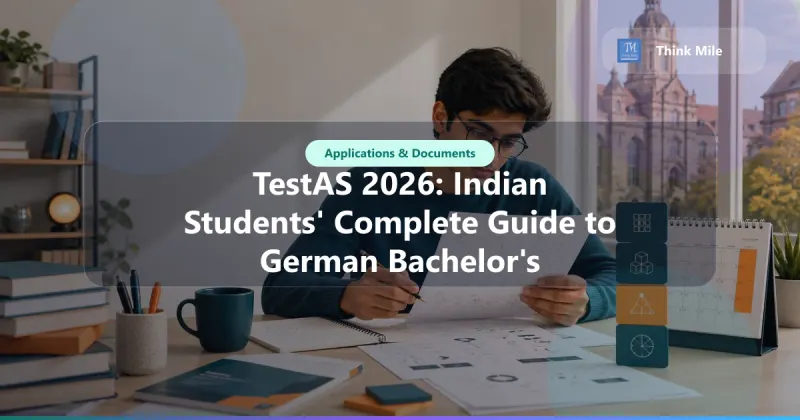
TestAS 2026: Indian Students' Complete Guide to German Bachelor's
You've shortlisted your German universities, your CGPA is decent, and then you notice a line buried in the international admissions page: "Non-EU applicants must submit a TestAS score." Or worse — you don't notice it, and your application gets disqualified. TestAS is a standardised academic aptitude test that many German universities use to evaluate international bachelor's applicants, and for Indian students it can either unlock competitive programmes or quietly kill an otherwise strong application.
This 2026 guide covers everything you need to know: what TestAS actually tests, which universities require it, how to register from India, how to prepare in 10–12 weeks, and what a competitive score looks like. Based on Ankit's experience guiding 500+ Indian students through the Germany application process, this is the most practical TestAS resource you'll find.
💡 Not sure if your target universities require TestAS? Message Ankit on WhatsApp — he'll tell you in 24 hours whether TestAS is on your checklist. Mentor Pack starts at ₹29,999. Package validity: One target intake or up to one year from the joining date, whichever comes first.
What Is TestAS?
TestAS (Test für Ausländische Studierende — "Test for Foreign Students") is a standardised academic aptitude test for international students applying to German universities. A few things to get straight immediately:
- It is NOT a German language test. TestAS measures cognitive and analytical ability, not language proficiency. (Though one sub-section does use German vocabulary — more on that below.)
- It is primarily for bachelor's applicants. Master's applicants are evaluated differently. If you already have a bachelor's degree, TestAS rarely applies to you.
- It is administered by the TestDaF Institute in cooperation with DAAD and the German Rectors' Conference (HRK) — two of Germany's most credible academic bodies.
- A strong TestAS score can compensate for a lower CGPA. Because Indian grading systems are hard to compare directly with German standards, a standardised aptitude score gives universities a neutral benchmark. If your CGPA is below 7.5, a TestAS score of 110+ can meaningfully strengthen your application.
For the full context on how Indian grades are evaluated, see our guide on CGPA to German GPA conversion.
Which Universities Require TestAS in 2026?
University policies on TestAS change every semester. Always verify directly on each university's international admissions page. That said, here is the current picture for Indian bachelor's applicants:
Universities That Require TestAS
| University | Programmes | Notes |
|---|---|---|
| RWTH Aachen | Engineering | Required for non-EU bachelor applicants |
| TU Munich (TUM) | STEM bachelor's | Required; also see JEE exemption note below |
| University of Stuttgart | Engineering | Required for direct bachelor's applicants |
| TU Berlin | Most bachelor's | Required for applicants without equivalent Abitur |
| TU Dortmund | Engineering / CS | Required |
| FH Aachen | Most bachelor's | Required |
| Hochschule München | Engineering | Required |
| University of Bonn | Some faculties | Verify per faculty |
Swipe horizontally to see more
Universities That Strongly Recommend TestAS (Treat as Required for Competitive Admission)
At these universities TestAS is not always mandatory on paper, but applicants without a score are at a significant disadvantage in competitive admissions:
- LMU Munich
- KIT Karlsruhe
- TU Dresden
- University of Hamburg
- Goethe University Frankfurt
Universities Where TestAS Is an Optional Bonus
Submitting a strong TestAS score here can differentiate your application but is not expected:
- Freie Universität Berlin
- Humboldt-Universität zu Berlin
- University of Mannheim
Important: These lists reflect the situation as of May 2026. Policies change per intake. Check the international admissions portal of every university you are targeting before you register for TestAS.
For a structured approach to building your university list, read How to Choose the Right University for Your Profile in Germany and use the AI University Finder to match programmes to your CGPA and background.
TestAS vs APS — Two Separate Requirements
This is one of the most common points of confusion for Indian applicants.
| APS Certificate | TestAS | |
|---|---|---|
| What it verifies | Authenticity of your Indian academic documents | Your academic aptitude and cognitive ability |
| Who administers it | German Embassy / APS India | TestDaF Institute |
| Is it mandatory? | Yes, for virtually all Indian applicants | Depends on university |
| Can one replace the other? | No | No |
| Timeline | 3–6 months (book early) | 4–6 weeks for results after test |
Swipe horizontally to see more
A strong TestAS score does not replace APS. Both are required for most Indian bachelor's applicants applying to public German universities. For the full APS process — documents, interview, timeline — read the Complete APS Guide for Indian Students.
TestAS Structure: Core Test + Subject Modules
TestAS has two parts you sit on the same day. You cannot split them across sessions.
Part 1: Core Test (All Candidates)
Every TestAS candidate takes the same three Core Test sections:
| Section | What It Tests | Indian Student Note |
|---|---|---|
| Quantity & Formal Relationships | Number and symbol pattern recognition; applying hidden rules. NOT computation-heavy. | JEE-prep students may find it intuitive but risk overthinking. Resist the urge to solve algebraically — look for the rule first. |
| Inductive Reasoning | Purely visual and abstract patterns. No language at all. Matrix completion, figural sequences. | The most trainable section. With focused practice, most students can improve significantly in 4–6 weeks. |
| Verbal Analogies | Word-pair relationships and semantic analogies — in German. Requires B1–B2 vocabulary. | Students below B1 German will struggle here. This section rewards early German prep alongside TestAS prep. |
Swipe horizontally to see more
Part 2: Subject Module (Choose One)
You choose one subject module at registration — and this choice is locked. You cannot change it on test day. Choose the module that matches the programme you are applying to.
| Module | For Applicants Targeting | What It Tests |
|---|---|---|
| Engineering (ING) | Engineering, architecture, technical programmes | Physics and math in technical contexts, spatial reasoning, technical diagrams, mechanical systems. PCM + JEE background is a genuine advantage here. |
| Math / CS / Natural Sciences (MIN) | CS, mathematics, physics, chemistry | Formal mathematical reasoning, functions, combinatorics, data interpretation. |
| Medicine / Life Sciences (MED) | Medicine, pharmacy, biology, nutrition | Biology and chemistry texts, experimental data interpretation, and a unique memorisation component (you study a data table and are tested on it later). Most linguistically demanding module. |
| Humanities / Social Sciences / Economics (GSW) | Business, economics, political science, social sciences | Reading comprehension, logical inference, abstract arguments — mostly in German. |
Swipe horizontally to see more
Choosing the wrong module wastes your test. If you're applying to both engineering and CS programmes, choose the module for your primary application target.
TestAS Scoring — What Is a Good Score?
| Score | Interpretation |
|---|---|
| Below 100 | Below average — unlikely to strengthen an application |
| 100 | Exactly average (mean = 100, standard deviation = 15) |
| 105–109 | Above average — acceptable at less competitive universities |
| 110–114 | Competitive — strong at most public universities |
| 115–119 | Very strong — approximately 84th percentile |
| 120–129 | Exceptional — approximately 91st percentile and above |
| 130 | Maximum score — approximately 98th percentile |
Swipe horizontally to see more
Target benchmarks for 2026 applicants:
- General target: 110+
- Selective programmes (TUM CS, RWTH Aachen Engineering, KIT): 115+
- CGPA below 7.0 and want to compensate: aim for 115+, ideally 118+
You receive separate scores for the Core Test and your Subject Module. Both matter. Universities typically look at both scores together.
Validity: TestAS scores are valid for 2 years from the test date. One April 2026 sitting covers applications for both WS 2026/27 and WS 2027/28.
Registration: How to Book TestAS from India
Test Centres in India (2026)
TestAS test centres in India include Mumbai, New Delhi, Chennai, Bangalore, Hyderabad, and Kolkata. Centre availability varies by test window — not all centres run every sitting. Always verify the current list on testas.de before planning travel.
Steps to Register
- Go to testas.de — no offline registration exists
- Create an account on the candidate portal
- Select your test date and test centre
- Choose your subject module (locked after registration)
- Pay the fee (approximately €60–€85 EUR — verify the current fee on the website)
- Receive confirmation and admit card
Critical Booking Tips
- Book 8–10 weeks in advance. Indian test centres fill fast, especially the April/May sittings which are most strategically timed for winter semester applications.
- Module selection is locked at registration. Changing it afterwards is not guaranteed. Think carefully before confirming.
- Results arrive 4–6 weeks after the test date. Factor this into your application timeline — if a June/July application deadline is your target, you need to have sat the test by April/May at the latest.
Strategic Test Date Planning for Indian Students
Optimal Window: April/May Sitting
For students targeting Winter Semester (October entry):
| Step | Timing |
|---|---|
| Take TestAS | April or May |
| Results arrive | May or June (4–6 weeks later) |
| Application deadlines | June–July at most universities |
| University entry | October |
Swipe horizontally to see more
This is the tightest viable window. If you miss the April/May sitting, results from a June sitting may arrive after application deadlines have closed.
Complete Timeline for WS 2027/28 Applicants (Starting Now — May 2026)
If you are reading this in May 2026 and planning for WS 2027/28, here is the full roadmap:
| Period | Action |
|---|---|
| May–June 2026 | Research target universities; confirm TestAS requirement per programme |
| June–July 2026 | Submit the APS application by post (there is no appointment booking; APS India publishes no official processing time, applicants report about 4–8 weeks) — do this first |
| July–August 2026 | Begin TestAS prep; take official practice test as baseline |
| August–September 2026 | Book TestAS for April/May 2027 |
| October–March 2026/27 | Intensive TestAS prep + German language development |
| November–December 2026 | APS certificate in hand; follow up with APS India if it has not arrived |
| April–May 2027 | Take TestAS |
| May–June 2027 | TestAS results arrive |
| June–July 2027 | Submit applications |
| October 2027 | Begin degree |
Swipe horizontally to see more
For the complete application timeline including SOP, LOR, and uni-assist deadlines, read How to Apply to a German University from India in 2026 and check German University Application Deadlines for 2026–27.
💡 Overwhelmed by the number of parallel tracks? Ankit has guided 500+ Indian students through exactly this process. Book a WhatsApp consultation to map your personal timeline — Mentor Pack ₹29,999. Package validity: One target intake or up to one year from the joining date, whichever comes first, 7-day money-back guarantee.
JEE Advanced — Does It Exempt You from TestAS?
Some Indian students with JEE Advanced scores ask whether they can skip TestAS entirely. The situation:
- RWTH Aachen has historically accepted strong JEE Advanced scores (roughly top 5,000 rank) as a TestAS alternative for engineering. Verify the current policy directly with RWTH Aachen's admissions office for your target intake.
- TU Munich and KIT may consider JEE Advanced scores, but there is no officially published threshold and no formal exemption policy in writing.
- Practical advice: do not rely on JEE Advanced as a TestAS substitute. Take TestAS and submit your JEE scorecard as a supporting document alongside it. This is the safer strategy that leaves no room for interpretation by an admissions officer.
How to Prepare for TestAS: 10-Week Strategy
Resources
| Resource | Type | Notes |
|---|---|---|
| Official practice tests on testas.de | Free online | Mandatory starting point — these are the most accurate representation of real test difficulty and format |
| Klett "Testtraining TestAS" book | Paid book (German) | The most comprehensive subject module workbook; available on Amazon India |
| DAAD India webinars | Free | Occasionally run TestAS orientation sessions — follow DAAD India on social media |
Swipe horizontally to see more
Week-by-Week Prep Plan (10 Weeks Out)
Weeks 10–9: Baseline and Orientation
- Take one full official practice test under timed conditions. No preparation — this is your honest baseline.
- Analyse which sections hurt most. Note your Core Test scores separately from your Subject Module score.
- Identify your German vocabulary level. If you're below B1, start vocabulary drills in parallel.
Weeks 8–6: Foundation Building
- Inductive Reasoning: 20 minutes daily on abstract pattern books. Books in any language work — this section is entirely visual. Focus on matrix completion and figural series.
- Verbal Analogies: Build German B1–B2 vocabulary in category-relationship pairs (e.g., dog:animal, red:colour). Use Anki flashcards.
- Subject Module: Begin content review. Engineering students: spatial visualisation, technical diagrams, secondary school physics. MIN students: functions, graphs, formal rule-application, combinatorics.
Weeks 5–3: Timed Practice and Mock Tests
- Move to full timed mock tests (Core + Subject together) — simulate real test conditions.
- Quantity & Formal Relationships: do speed drills on number series and symbol pattern completion. Resist JEE-style computation — look for the rule, not the answer.
- Subject Module: go deeper on the weakest topic areas identified in week 6.
Weeks 2–0: Targeted Reinforcement
- No new content. Work only on demonstrably weak sub-sections from mock test analysis.
- Run one final full mock 3–4 days before the test.
- Day before: review test centre logistics, take it easy.
Section-by-Section Tips
Inductive Reasoning — Most trainable. Pure pattern recognition, no language, no domain knowledge. Daily short practice produces measurable improvement. Start here.
Quantity & Formal Relationships — JEE background is helpful but can mislead. The section rewards rule-finding speed, not computation. When you see a number sequence, identify the generative rule before calculating anything.
Verbal Analogies — Requires German vocabulary. B1 is the floor; B2 is comfortable. Category-relationship pairs are the most common format: practice identifying whether pairs are "type of," "part of," "opposite," or "sequence."
Engineering Module (ING) — Spatial visualisation is the distinguishing skill. Practice rotating 3D objects mentally. Technical diagram reading is secondary school level but students who haven't seen technical drawings recently should review.
MIN Module — Formal reasoning over computation. Functions, graph reading, and combinatorics at A-level (Class 12) standard. Data interpretation questions require careful reading under time pressure.
After the Test: Submitting Your Score
- Scores are published in your testas.de candidate portal 4–6 weeks after the test date.
- Download the official PDF score report.
- Self-submission: most universities ask you to upload the PDF directly in your application portal or send it by email. Some require official transmission directly from TestDaF — check the admissions instructions for each university.
- One test, unlimited submissions: there is no per-university fee for sending your TestAS score. A single test session covers every application you submit.
- Score validity: 2 years. One April 2026 sitting covers WS 2026/27 and WS 2027/28 applications.
TestAS and the Studienkolleg Path
If you are applying to German universities as a Class 12 graduate (without a bachelor's degree), you may also need to consider whether you qualify for direct admission or need Studienkolleg.
The short version: most Indian Class 12 graduates with 12 years of schooling need Studienkolleg before a bachelor's programme. A strong TestAS score can sometimes support a direct admission case, but it does not automatically replace Studienkolleg eligibility requirements.
If you are unsure whether your Class 12 qualification grants direct university access in Germany, that guide explains the eligibility rules in detail.
For the full Germany application roadmap from the very beginning, the Complete Roadmap for Indian Students Studying in Germany maps every step from shortlisting to arrival.
Frequently Asked Questions (FAQ)
Is TestAS mandatory for all Indian students applying to German universities?
No. TestAS is required by specific universities and specific programmes — not by all German universities. The requirement is most common at public research universities for non-EU bachelor's applicants. Master's applicants rarely need TestAS. Always check the international admissions page of each university you are applying to. Policies are updated every intake.
What is a good TestAS score for Indian students in 2026?
A score of 110 or above is considered competitive at most public German universities. For selective programmes at TU Munich, RWTH Aachen, or KIT, aim for 115+. If your CGPA is below 7.0 and you need your TestAS score to compensate, target 115–120. The test is scored on a scale of 70–130 with a mean of 100 and a standard deviation of 15.
Can I take TestAS in English?
The Inductive Reasoning section has no language at all. The Verbal Analogies section is in German (no English option). Subject modules are available in German and sometimes in English — check the current language options on testas.de for your chosen module and test centre, as this varies by sitting.
How many times can I take TestAS?
You can take TestAS more than once. Your scores are valid for 2 years from each test date. If you are not happy with your first attempt, you can sit again in the next available window. There is no official restriction on repeat attempts, but check the current policy on testas.de.
Does my JEE Advanced rank exempt me from TestAS?
Possibly at RWTH Aachen (historically, top ~5,000 JEE Advanced rank), but this policy changes and is not guaranteed. TU Munich and KIT may consider JEE Advanced scores, but there is no official written exemption policy. The safe strategy: take TestAS and submit your JEE scorecard as a supporting document. Do not rely on an informal JEE exemption.
How early should I book TestAS from India?
Book 8–10 weeks before your target test date, minimum. Indian test centres — especially Mumbai, New Delhi, and Bangalore — fill up quickly for the strategically important April/May sittings. If you are targeting WS 2027/28, register for an April or May 2027 sitting no later than February 2027.
Is TestAS the same as the DSH or TestDaF German language test?
No. TestAS, DSH, and TestDaF are entirely different tests. DSH and TestDaF are German language proficiency tests required for admission to German-taught programmes. TestAS tests cognitive and academic aptitude — it is not a language test (though the Verbal Analogies section requires German vocabulary). Many Indian students need both TestAS and a German language certificate if they are applying to German-taught bachelor's programmes.
What happens if I choose the wrong subject module?
Your TestAS result will still be valid, but a score on the wrong module is unlikely to satisfy the university's requirement and may not be accepted. Module selection is locked at registration and cannot be changed on test day. If you are applying to both engineering and CS programmes, choose the module for your primary application target (usually Engineering/ING).
Why Choose Think Mile?
Preparing for TestAS while also managing APS, German language, SOPs, LORs, and application deadlines is genuinely complex — especially when you are doing it from India without institutional support. 500+ Indian students have navigated this process with Ankit's guidance, including students who secured seats at RWTH Aachen, TU Munich, and KIT.
Think Mile's Mentor Pack (₹29,999. Package validity: One target intake or up to one year from the joining date, whichever comes first) covers:
- Personalised TestAS strategy based on your module and timeline
- SOP and LOR review (2 rounds each)
- University shortlist review against your CGPA, TestAS target, and APS status
- Unlimited visa Q&A
- 7-day money-back guarantee — full refund if requested within 7 days, no questions asked
If you want full end-to-end support from application to arrival, the Premium Package (₹80,000) includes everything with priority access and a full refund if no admission is received.
Last reviewed: 28 May 2026. TestAS policies and university requirements change each intake — always verify on testas.de and each university's international admissions page.
Planning your own application? Read our full guide: APS certificate for Germany: documents, interview and timeline
Free AI tools — quick, free signup
Generate your SOP, find universities, and prep for visa — for free
Think Mile's AI tools do the research work. Start with University Finder and upgrade to expert review when you're ready.
We earn nothing from universities. Ever.
Free email guide
Germany Application Master Checklist 2026
10-step checklist + every free tool linked, delivered to your inbox.
No spam. Unsubscribe any time.
Related Articles
Continue reading about Applications & Documents