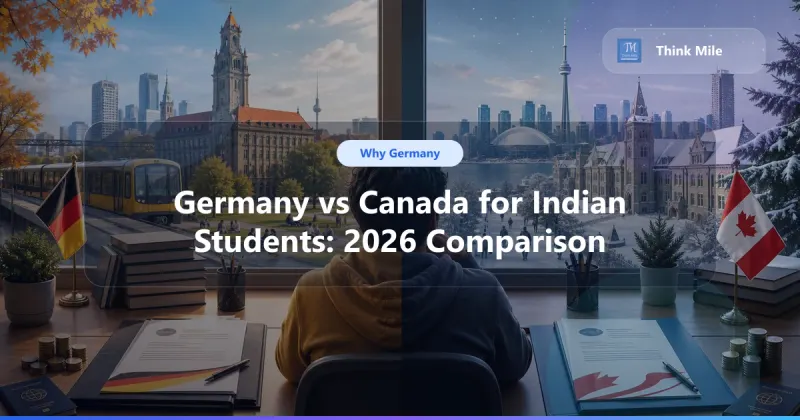
Germany vs Canada for Indian Students: 2026 Comparison
Germany and Canada offer different study, work and immigration systems. Neither country is the automatic winner for every Indian student.
A useful comparison must start with two real offers. National averages cannot tell you whether a particular degree is academically suitable, affordable, eligible for post-study work or connected to your target occupation.
This guide reflects official rules checked on 8 June 2026. Immigration thresholds and programme eligibility can change, so retain dated evidence before paying a deposit.
Short Answer
Germany may fit better when:
- a suitable public programme charges little or no tuition;
- your prior coursework meets a consecutive degree's requirements;
- you can build German ability for daily life and the target labour market;
- your preferred employers and occupation are present in the relevant region;
- your budget benefits materially from lower tuition.
Canada may fit better when:
- the exact Canadian programme has stronger curricular or co-op value;
- the institution and programme are confirmed as eligible for your intended post-study route;
- English or French aligns better with your academic and career plan;
- you can fund tuition and living costs without relying on future employment;
- your occupation, province and immigration profile support a credible post-study plan.
Do not select either country only because someone promises permanent residence.
Compare Offers, Not Countries
Build one evidence table for each offer.
| Question | Germany | Canada |
|---|---|---|
| Is the programme recognised? | Check the state or state-recognised institution, degree regulations and Higher Education Compass | Check the designated learning institution, provincial recognition and exact programme |
| Are you academically eligible? | Degree equivalence, subject credits, grade and language rules | Institution-specific degree, grade, prerequisite and language rules |
| What is the total tuition? | Programme and semester fee regulations | Official tuition quote for the programme and international status |
| What is the realistic budget? | City housing, insurance, semester contribution, tuition and arrival reserve | Province/city housing, health coverage, tuition, fees, travel and arrival reserve |
| Can you work during study? | Residence and student-status rules | Study-permit conditions and enrolment status |
| Is post-study work available? | German-graduate job-search permit or direct skilled-work title | Exact DLI/programme PGWP eligibility plus graduate requirements |
| Is permanent residence plausible? | Employment title, salary, pension contributions, language and other conditions | Express Entry, provincial or other programme criteria and ranking |
| What is the family impact? | Residence-title and family-reunification rules | Programme-dependent spouse work-permit rules and family funding |
Swipe horizontally to see more
If a critical answer is unknown, the comparison is incomplete.
Tuition
Germany
Many public German degree programmes do not charge general tuition, but there are important exceptions:
- Baden-Wuerttemberg generally charges many non-EU students EUR 1,500 per semester, subject to exemptions;
- Bavarian institutions may set tuition for students from third countries;
- TUM, for example, charges programme-specific non-EU tuition for many degrees;
- continuing-education, non-consecutive and private programmes may charge substantial tuition;
- all students may still owe semester contributions and programme costs.
Verify the university's fee regulations for the exact semester. Do not describe every public degree as free.
Canada
Canada's public universities and degree-granting colleges charge international tuition that varies by province, institution and field. McGill University, the University of British Columbia and the University of Toronto are public institutions, not private universities.
Statistics Canada reported average 2025/26 international tuition of:
- CAD 41,746 for full-time undergraduate students;
- CAD 24,028 for full-time graduate students.
These are national averages, not price quotes. International graduate tuition ranged substantially by province, and professional programmes can cost much more.
Cost comparison rule
Compare:
Tuition
+ mandatory university fees
+ realistic housing
+ insurance and health costs
+ food and transport
+ visa/residence and document costs
+ travel and setup
+ emergency reserve
- confirmed scholarships or funding
= total amount at risk
Do not convert a multi-year total using one assumed INR exchange rate. Model exchange-rate and tuition-increase scenarios.
Proof of Funds Is Not a Full Budget
Germany
For 2026, federal guidance uses EUR 11,904 per year, or EUR 992 per month, as the study-funding reference. Tuition must be financed separately where it applies. Other accepted funding evidence may be available.
The amount is a residence requirement, not proof that Munich, Berlin or another city will fit your budget.
Canada
For study-permit applications made on or after 1 September 2025 outside Quebec, IRCC requires one applicant to show CAD 22,895 for first-year living expenses.
This amount excludes:
- tuition;
- transportation to and from Canada;
- additional funds for accompanying family members.
Applicants must show first-year resources and explain how they will fund the full programme when it lasts longer than one year. Quebec applies its own financial rules.
The old CAD 10,000-CAD 15,000 comparison is no longer valid.
Study-Permit Context
Germany
The German study route generally requires admission, secured funding, any required language evidence and health-insurance arrangements. Indian applicants must follow the current German mission and APS instructions.
An offer does not guarantee a visa. Avoid publishing a universal processing timeline.
Canada
Canada's international-student cap remains relevant in 2026. IRCC expects to issue up to 408,000 study permits, including 155,000 for newly arriving students and 253,000 extensions.
The cap limits applications accepted for processing in categories requiring a provincial or territorial attestation letter. It does not mean every applicant has the same approval probability.
Starting 1 January 2026, applicants to degree-granting master's or doctoral programmes at a public DLI are exempt from the PAL/TAL requirement. Other students must check the current exemption list and obtain a valid PAL/TAL where required.
Working During Study
Germany
Current federal guidance generally permits third-country students to work up to 140 full or 280 half days per year. The 20-hour framework also matters for student status and social insurance. Student-assistant work, internships and self-employment can follow additional rules.
Germany's statutory minimum wage is EUR 13.90 gross per hour in 2026 where it applies.
Canada
Eligible international students may currently work up to 24 hours per week off campus during regular academic sessions and full time during eligible scheduled breaks.
Eligibility depends on factors including:
- a valid study permit with work conditions;
- full-time study at a DLI, subject to the final-semester exception;
- an eligible programme at least six months long leading to a credential;
- a Social Insurance Number;
- active pursuit of studies.
From 1 April 2026, eligible post-secondary students no longer need a separate co-op work permit for a placement required by their programme, but the placement and study-permit conditions still need verification.
In both countries, work is uncertain income. Your initial budget should work without it.
Post-Study Work
Germany
A third-country graduate who successfully completes a German degree may apply for a residence permit for up to 18 months to seek qualified employment, provided the applicable conditions such as livelihood and health coverage are met. During this period, any type of employment is allowed.
The permit is not automatically issued for every foreign degree and is not renewable as a second 18-month search period. A graduate with a suitable offer may instead move directly to an eligible skilled-work residence title.
Canada
A PGWP is not attached automatically to every Canadian programme. Verify:
- the institution is a DLI;
- the exact programme is PGWP-eligible;
- you will meet study-status and completion rules;
- the credential's language requirement;
- any applicable field-of-study requirement;
- passport validity and application deadline.
For PGWP applications submitted on or after 1 November 2024:
- bachelor's, master's and doctoral graduates require at least CLB/NCLC 7 in all four language abilities;
- those degree graduates do not face a field-of-study requirement;
- other university programmes also require CLB/NCLC 7;
- college, polytechnic and other non-university programmes generally use CLB/NCLC 5 and may face eligible-field rules.
Canada has frozen the PGWP field-of-study list for 2026. A qualifying master's degree of at least eight months can support a PGWP of up to three years, subject to the full rules and passport validity.
Permanent Residence: Compare Conditions, Not Promises
Germany
The EU Blue Card is one possible work title, not the only skilled-work route.
For 2026, the official thresholds are:
- EUR 50,700 gross annual salary for the general Blue Card route;
- EUR 45,934.20 for shortage occupations, subject to Federal Employment Agency approval;
- EUR 45,934.20 for qualifying new labour-market entrants whose latest degree was obtained less than three years earlier, also subject to approval.
Blue Card holders may qualify for a settlement permit after:
- 27 months of qualifying employment and pension contributions with A1 German; or
- 21 months with B1 German;
provided all other statutory conditions are met.
A graduate of a German university may also qualify under the skilled-worker settlement route after two years on a qualifying skilled-work residence title and 24 months of pension contributions, with the remaining conditions. Study start to settlement is therefore not a fixed four-and-a-half-year formula.
Canada
Canadian education and work experience can support permanent-residence pathways, but graduation does not guarantee selection.
The Canadian Experience Class currently requires at least one year or 1,560 hours of qualifying paid Canadian work in TEER 0, 1, 2 or 3 during the preceding three years. Work gained while studying full time does not count toward that minimum.
Meeting CEC eligibility allows a candidate to enter the Express Entry pool. It does not guarantee an invitation. Invitations depend on:
- Comprehensive Ranking System score;
- draw type;
- current categories;
- language;
- age;
- education;
- qualifying work;
- provincial nomination or other factors.
CRS cutoffs vary between general, programme-specific and category-based rounds. A static "490-530+" range is not a reliable planning rule. Provincial programmes also change and usually carry province-specific conditions.
Do not publish a guaranteed seven-to-nine-year Canada timeline or claim Germany has a lottery-free guaranteed PR path. Both systems require future facts that a student cannot control at admission.
Family Rules
Family plans can change the financial comparison.
In Canada, since 21 January 2025, a spouse or common-law partner of an international student may qualify for an open work permit when the student is in:
- a master's programme lasting at least 16 months;
- a doctoral programme;
- certain listed professional or eligible programmes.
Eligibility is not universal. Accompanying family also increases proof-of-funds requirements.
Germany has separate family-reunification rules involving residence status, family relationship, livelihood, insurance, housing and other conditions. Do not assume that every student's spouse has identical work or language rights.
Get case-specific official advice before using anticipated spouse income in the budget.
Health Coverage
Germany
Student insurance depends on age, prior insurance, programme and legal status. Compulsory student statutory insurance generally applies only until completion of age 30, subject to statutory exceptions. Contributions vary by insurer and are updated.
Do not use a fixed EUR 125-EUR 145 figure for every applicant.
Canada
Health coverage is provincial and institution-specific. International students may use a provincial plan, university plan or private coverage depending on location and status. Waiting periods, services, premiums and eligibility can change.
Do not compare Canada using one national monthly health-insurance price. Request the exact university and provincial coverage terms, including prescription, dental, vision and mental-health limitations.
Language and Career Access
An English-taught German degree does not make the German labour market English-only. German requirements vary by occupation, employer, location, customer contact and regulation.
Canada is not uniformly English-only either. French is central in Quebec and can affect study, licensing, employment and immigration options elsewhere. Regulated professions in both countries may require recognition, licensing and language evidence beyond the degree.
For each target role, collect at least 20 current vacancies and record:
- required language;
- tools and qualifications;
- licensing or recognition;
- experience;
- location;
- salary;
- work-authorisation wording.
Use Germany's Entgeltatlas and Canada's Job Bank rather than generic salary tables.
Education Quality
Country rankings do not decide programme fit.
Compare:
- accreditation and recognition;
- curriculum and module depth;
- faculty and research fit;
- co-op, internship or thesis structure;
- access to laboratories and supervisors;
- class delivery and assessment;
- graduate evidence for the exact programme;
- total cost per completed credential.
TU9 membership is not an admissions or employment guarantee. Canadian university rank is not evidence that every programme provides co-op or PGWP eligibility.
Housing and Daily Life
Housing varies more by city than by national slogan.
For each offer, verify:
- realistic room listings near campus;
- residence availability and application process;
- deposits and utilities;
- commute time;
- registration requirements;
- temporary-housing backup;
- fraud controls.
Avoid national rent tables and climate stereotypes. Compare the actual cities and neighbourhoods. A lower-tuition offer can become unaffordable if housing is unavailable.
Decision Scorecard
Reject an offer first if academic eligibility, recognition, funding or immigration assumptions are unresolved. Score the remaining offers:
| Category | Suggested weight |
|---|---|
| Academic and curriculum fit | 25% |
| Total cost and debt risk | 20% |
| Housing and family feasibility | 15% |
| Role-specific labour-market fit | 15% |
| Language and licensing burden | 10% |
| Post-study work eligibility | 10% |
| Permanent-residence resilience | 5% |
Swipe horizontally to see more
Permanent residence receives a low weight because rules and personal eligibility can change over several years. A degree should remain worthwhile even if immigration policy becomes less favourable.
Stress-Test Both Options
Run these scenarios:
- You find no student job for the first year.
- Housing costs 25% more than expected.
- The exchange rate moves against INR.
- You do not secure a graduate job for nine months.
- Your spouse cannot work.
- You do not qualify for a Blue Card, PGWP or preferred PR stream.
- You return to India after graduation.
The stronger offer is the one that remains financially and professionally defensible under several scenarios.
Red Flags
Recheck any source claiming:
- Germany always has zero public-university tuition;
- Baden-Wuerttemberg charges EUR 3,000 per semester;
- McGill, UBC or Toronto are private universities;
- Canada requires only CAD 10,000-CAD 15,000 in living funds;
- Canadian students may work only 20 hours weekly in 2026;
- every Canadian degree qualifies for a three-year PGWP;
- every PGWP applicant faces the same field-of-study rule;
- Canada guarantees PR after one year of work;
- one CRS cutoff range predicts future invitations;
- Germany guarantees settlement if a salary threshold is met;
- Germany's 2026 Blue Card thresholds are EUR 45,552 and EUR 41,042;
- all Blue Card holders need B1 for settlement;
- a German graduate's only settlement route takes five years;
- one national salary, healthcare, rent or climate table represents either country;
- a field such as STEM, business or healthcare automatically determines the winning country.
Frequently Asked Questions
Which country is cheaper?
Germany often has lower tuition at public institutions, but exceptions matter. Compare complete offers, cities, family needs and exchange-rate risk.
Which country offers easier permanent residence?
Neither offers automatic PR. Germany uses residence-title and contribution conditions; Canada uses programme eligibility, work experience, ranking and changing selection streams. Model your exact route.
Can I fund study through part-time work?
Do not plan on it in either country. Work availability, legal limits, taxes, study load and housing costs create substantial uncertainty.
Does every Canadian master's receive a three-year PGWP?
No. The degree, duration, institution, programme, study history, language result, passport and application compliance all matter.
Is German mandatory in Germany?
It may not be required for an English degree, but it can materially affect housing, daily administration, regulated professions and employment.
Is Canada fully English-speaking?
No. Canada is officially bilingual, and French is especially important in Quebec. Programme, profession, province and immigration route determine the practical requirement.
Should PR determine the decision?
No. Choose a degree that remains academically and financially worthwhile without guaranteed immigration.
The correct comparison is not Germany versus Canada in the abstract. It is one verified German offer versus one verified Canadian offer, tested against your finances, occupation, language capacity, family plan and downside risk.
Planning your own application? Read our full guide: How to study in Germany from India
Free AI tools — quick, free signup
Generate your SOP, find universities, and prep for visa — for free
Think Mile's AI tools do the research work. Start with University Finder and upgrade to expert review when you're ready.
We earn nothing from universities. Ever.
Free email guide
Germany Application Master Checklist 2026
10-step checklist + every free tool linked, delivered to your inbox.
No spam. Unsubscribe any time.
Related Articles
Continue reading about Why Germany