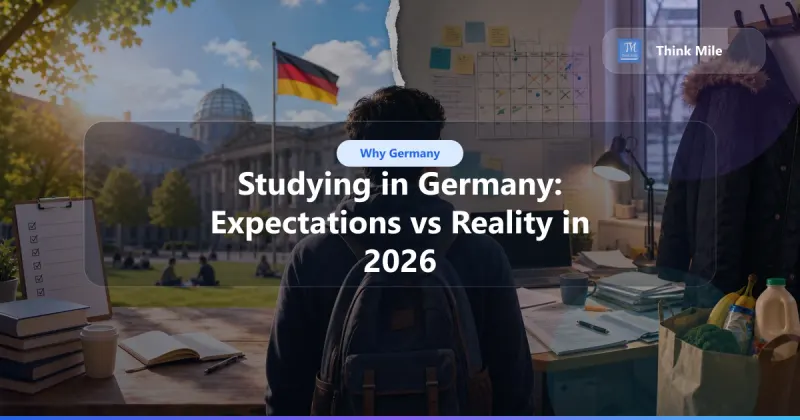
Studying in Germany: Expectations vs Reality in 2026
Studying in Germany is neither the effortless low-cost experience promoted in some videos nor a universally difficult experience. Outcomes vary by programme, city, housing situation, finances, language ability and personal circumstances.
The useful question is not whether one person's story is true. It is whether their conditions match yours.
This guide turns common expectations into checks you can complete before accepting an offer. It distinguishes national rules from university, city and individual variability.
Reality Check at a Glance
| Expectation | More accurate planning assumption |
|---|---|
| Public university means no tuition | Many public programmes charge no general tuition, but important state, university and programme exceptions exist |
| The blocked-account amount is a full budget | It is a residence-funding reference, not proof that your actual city budget will work |
| The university will provide housing | Housing is usually a separate application, and supply is limited |
| Every module has one final exam | Assessment follows the programme and module regulations |
| An English degree means an English-only life | The curriculum may be English while housing, administration and many jobs require German |
| A student job will finance the degree | Employment is uncertain, legally limited and may conflict with study progress |
| A German degree guarantees a job | The degree provides a residence and recruitment opportunity, not an employment guarantee |
| All students experience Germany similarly | Institution type, subject, city, income, health, identity and support network change the experience |
Swipe horizontally to see more
What Current Evidence Actually Shows
Germany hosts a large and growing international student population. DAAD reported about 402,000 international students and doctoral candidates in winter semester 2024/25. India was the largest country of origin, with 59,419 Indian students.
Scale does not remove friction. In a DAAD survey for winter semester 2024/25, participating universities identified entry and visa processes, affordable housing, and study and living costs as major barriers for international students.
These figures establish that the challenges are real. They do not establish that every student will face a particular waiting time, number of rejected housing applications, exam failure, period of loneliness or job-search duration.
Academics: Inspect the Rules, Not the Stereotype
Expectation: Every German degree is completely self-directed
Reality: Academic structure varies by institution, programme and module.
A research university may place substantial responsibility on independent study. A university of applied sciences may use more scheduled laboratories, projects or attendance requirements. Either type can contain lectures, tutorials, seminars, group work, practicals and compulsory participation.
Before enrolment, obtain:
- the study and examination regulations;
- the module handbook;
- the recommended semester plan;
- the examination registration and withdrawal rules;
- the rules for failed attempts, deadlines and final failure;
- the current semester schedule.
Expectation: One final exam always determines the grade
Reality: Assessment can include written exams, oral exams, assignments, laboratories, presentations, projects, portfolios or combinations of these.
Check each module description. Do not assume that assignments are ungraded, that attendance is optional or that every failed examination has two retakes. Consequences of final failure can be serious and are governed by the applicable examination regulations.
Expectation: Admission means your prior preparation is sufficient
Reality: Admission confirms that the institution applied its admission process. It does not guarantee that every advanced module will be easy or that prior curricula align perfectly.
Compare your bachelor's modules with the first-semester content. If you identify gaps in mathematics, programming, academic writing, laboratory methods or the language of instruction, prepare before arrival and use bridging support offered by the university.
Tuition and Living Costs: Build an Offer-Specific Budget
Expectation: Public higher education is free
Reality: "No general tuition" is not the same as "no education cost."
Possible charges include:
- tuition for non-EU students in Baden-Wuerttemberg, subject to statutory exceptions;
- institution-level tuition at some Bavarian universities;
- tuition for continuing-education or non-consecutive programmes;
- programme-specific fees;
- semester contributions;
- examination, laboratory, excursion or material costs;
- student-service and transport components.
Verify the fee regulations for the exact programme and semester. Do not extrapolate from another public university.
Expectation: EUR 11,904 guarantees one comfortable year
Reality: For 2026, EUR 11,904 is the federal annual funding reference for the study residence route. It is not a national estimate of every student's real expenses.
Construct three scenarios:
| Scenario | Housing | Employment income | Unexpected costs |
|---|---|---|---|
| Minimum viable | Confirmed low-cost room | EUR 0 | Small reserve |
| Expected | Realistic private-market room | Conservative income after settling | Normal setup and travel |
| Stress | Temporary or expensive housing | EUR 0 | Deposit, replacement items, medical or travel expense |
Swipe horizontally to see more
Include tuition, semester contribution, rent, deposit, utilities, insurance, food, communication, transport, residence costs, study materials and travel. Do not count a deposit as a normal monthly expense, but ensure cash is available when it is due.
Current national reference points include:
- EUR 13.90 gross hourly minimum wage from 1 January 2026, where the statutory minimum applies;
- a EUR 603 average monthly minijob threshold in 2026;
- a EUR 63 monthly Deutschlandticket, although participating universities may offer a discounted Deutschlandsemesterticket;
- a EUR 992 monthly study-funding reference for residence purposes.
These numbers do not create a complete personal budget. Health-insurance status, rent and tuition can change the result substantially.
Housing: Treat It as a Capacity Problem
Expectation: Admission includes accommodation
Reality: A university offer normally does not reserve a room.
Studierendenwerk housing is affordable but limited. Deutsches Studierendenwerk reports roughly 196,000 residence places and an average gross rent around EUR 306 on its English housing page, while also warning of long waiting lists in many locations at the start of winter semester.
The average is not a quote for your city or room. Each local Studierendenwerk has its own stock, eligibility rules, application dates and waiting process.
Expectation: One national housing timeline applies
Reality: Search difficulty differs sharply by city, semester, room type, budget and household.
Build a housing plan with:
- local Studierendenwerk application;
- private WG and rental channels;
- university or city housing boards;
- a lawful temporary option that states whether address registration is possible;
- a maximum monthly rent and deposit limit;
- fraud controls before transferring money.
Never pay solely because a listing creates urgency. Verify the landlord or authorised subletter, contract, address, viewing process, deposit terms and method of key transfer. Avoid sending identity documents with unnecessary data to unverified recipients.
Germany generally requires residence registration within two weeks after moving into a registrable home. Federal guidance notes that some temporary accommodation cannot be registered, so confirm this before booking.
Student Work: Opportunity, Not Funding Proof
Expectation: Every international student can work 20 hours each week
Reality: Several legal and social-security concepts overlap.
Current federal guidance states that students from third countries may generally work up to 140 full or 280 half days per year. It also discusses the 20-hour framework and separate treatment for certain student auxiliary activities. The effect of a specific job depends on residence status, working days, hours, term time, self-employment rules, taxes and social insurance.
Use the official study-and-work guidance, then confirm unusual arrangements with the competent authority.
Expectation: Minimum wage predicts take-home income
Reality: It is a gross statutory floor for covered employment, not a guaranteed student wage or net-income figure.
Hours may be irregular. Mandatory internships, some voluntary internships and student assistant roles can follow different rules. Taxes, pension contributions and insurance status depend on the arrangement.
Do not fund the visa or first months with an assumed future job. A conservative plan works with no employment income during the housing search, onboarding and first examination period.
German can widen the available market, especially for customer-facing and locally operating employers. It does not guarantee a job by a particular date.
Language: Split Classroom and Life Requirements
Expectation: English-taught means everything is available in English
Reality: The programme language controls the curriculum, not the language of the entire city.
Verify separately:
- teaching and examination language;
- whether enough electives are offered in that language;
- landlord and contract communication;
- city and immigration-office services;
- medical access;
- student-job and graduate-job requirements;
- social and extracurricular participation.
Some authorities and service providers offer English support, while others do not. Do not claim that every official process is exclusively German or that staff are never able to help in English.
Start with language skills appropriate to your actual risks. A fixed A2, B1 or B2 recommendation cannot cover every degree, city and target role. Continue learning after arrival and use qualified help for contracts or legal correspondence you do not understand.
Bureaucracy: Build a Dependency Map
Expectation: Every student follows one fixed sequence and timeline
Reality: Tasks have dependencies, but routes and processing times vary.
A typical control list includes:
- admission and any enrolment conditions;
- visa and entry conditions;
- valid health-insurance evidence;
- housing and address-registration capability;
- enrolment and semester payment;
- residence registration after moving in;
- bank and communication arrangements;
- residence-permit application where required;
- broadcasting contribution and household coordination.
Do not publish or rely on universal APS, visa-appointment, visa-processing or residence-permit timelines. Use the German mission in India's current instructions, APS, university and local authority pages. Keep dated copies of submitted forms and confirmations.
Social Life: Avoid National Personality Claims
Expectation: A diverse friend group forms automatically
Reality: Enrolment creates contact opportunities, not guaranteed relationships.
Programme size, housing, language, commute, work hours and recurring activities influence social contact. Useful entry points include orientation events, Fachschaft activities, Hochschulsport, student societies, language exchanges, volunteering and residence events.
Recurring participation is more controllable than waiting for spontaneous invitations. Indian student associations can provide practical and cultural support, but no student should feel required to socialise only within or outside a national group.
Avoid describing Germans as uniformly cold, reserved, loyal or direct. These are cultural stereotypes, not reliable forecasts about individuals.
DAAD recorded 59,419 Indian students in Germany in winter semester 2024/25, but local community size varies. Check the actual university and city rather than assuming every campus has the same network.
Wellbeing: Plan Support Without Predicting a Crisis
Expectation: Moving abroad will either be exciting or mentally damaging
Reality: Adjustment is individual and can change over time.
Housing instability, financial pressure, academic workload, discrimination, illness, language barriers, distance from family and reduced daylight can affect wellbeing. It is not responsible to diagnose seasonal affective disorder or claim that every student's first winter is the hardest period.
Before arrival, record:
- your university's counselling service;
- the local Studierendenwerk counselling contact;
- health-insurance routes for medical and psychotherapeutic care;
- emergency numbers and crisis services;
- accessibility or disability support;
- one trusted contact in Germany and one at home.
Deutsches Studierendenwerk lists psychological counselling services across many student-service organisations. Availability, language and waiting times are local. For an acute crisis, use emergency or crisis services rather than waiting for a routine university appointment.
Food, Weather and Daily Life: Research the Location
Expectation: One description fits all of Germany
Reality: Daily life differs by region and household.
Indian ingredients, vegetarian options and restaurant prices vary by city. Search current maps and local student groups, then learn several low-cost meals before arrival if you plan to cook.
Weather also varies. Coastal northern Germany, inland eastern Germany, the Rhine region and Alpine southern Germany do not share one winter pattern. Use long-term data from the German Weather Service for the city, and buy clothing based on local conditions and your needs rather than a universal EUR 150-EUR 300 list.
Check whether the room is furnished, whether a kitchen is installed, which utilities are included, how waste separation works, and whether the broadcasting contribution is already paid by someone in the household.
Careers: A Degree Is One Input
Expectation: Graduation guarantees 18 months and then a Blue Card
Reality: Graduates of German higher education can generally apply for a residence permit for up to 18 months to seek qualified employment if they meet the applicable conditions. A job and an EU Blue Card are separate outcomes.
For 2026, official guidance lists:
- EUR 50,700 as the general Blue Card salary threshold;
- EUR 45,934.20 for listed shortage occupations, subject to the applicable conditions;
- EUR 45,934.20 for qualifying recent graduates within three years of graduation, with Federal Employment Agency approval.
Check the current EU Blue Card requirements when you have an offer. Other skilled-worker residence routes may be available if a role does not meet the Blue Card rules.
Expectation: German at B2 plus one internship guarantees employment
Reality: No combination guarantees a job.
Research target roles by collecting current vacancies:
| Evidence | Questions |
|---|---|
| Technical requirements | Which methods, tools, licences or domain knowledge recur? |
| Language | Is German mandatory, preferred or absent? |
| Experience | Do internships, working-student roles or prior overseas experience count? |
| Location | How many suitable employers operate within a realistic commute? |
| Salary | What does the Federal Employment Agency's Entgeltatlas show for the occupation and region? |
| Residence route | Does the role qualify as skilled employment, and which permit conditions apply? |
Swipe horizontally to see more
Start career preparation early, but do not treat networking, LinkedIn, a career fair or a Werkstudent role as a guaranteed pipeline.
Your Pre-Arrival Evidence Pack
Before accepting an offer, assemble:
- programme regulations and module handbook;
- total fee evidence for the exact semester;
- minimum, expected and stress budgets;
- housing channels and temporary backup;
- insurance assessment;
- official visa and APS checklists;
- city registration and immigration links;
- student-work rules;
- university support contacts;
- five to ten representative graduate vacancies;
- a no-job and delayed-housing contingency plan.
Red Flags
Recheck any source claiming:
- every German university uses one final exam worth 100%;
- most international students fail in the first semester;
- every failed exam permits exactly two retakes;
- dorm waiting lists are universally 6-18 months;
- every student sends 50-100 housing applications;
- one fixed rent table represents entire cities;
- the blocked account will be sufficient everywhere;
- part-time work is easy, arrives within a fixed number of weeks or can safely fund the degree;
- the 2026 minimum wage is still EUR 12.82;
- the minijob threshold is still EUR 538;
- the Deutschlandticket is still EUR 58;
- the student-work allowance is still 120 full or 240 half days (it was raised to 140/280 in March 2024);
- German friendships take a fixed number of months;
- every international student's first winter causes a mental-health condition;
- APS, visa or residence processing follows one guaranteed timeline;
- a German master's, B2 German or local internship guarantees employment;
- outdated Blue Card thresholds apply to a 2026 offer.
Frequently Asked Questions
Is studying at a German public university free?
Not necessarily. Verify tuition and semester charges for the institution, programme, nationality and semester. Housing, insurance and living costs remain even where general tuition is not charged.
Can part-time work cover all expenses?
Do not plan on it. Availability and income are uncertain, work is legally constrained, and excessive work can harm study progress.
Is German required for an English master's?
The university may not require German for admission, but German can matter for housing, administration, healthcare, social participation and employment. Check each context separately.
Will the university find housing?
Usually not. Local student services may operate residences and advice services, but a place is not normally guaranteed by admission.
Are German universities harder than Indian universities?
That comparison is too broad. Compare assessment, workload, prerequisite knowledge and study structure for the exact programme.
Does a German degree guarantee a graduate job?
No. It can support access to the labour market and a post-study job-search residence route, but employment depends on the role, skills, language, experience, location and economic conditions.
The most realistic expectation is not that Germany will be easy or difficult. It is that the important constraints can be identified, sourced and budgeted before they become emergencies.
Planning your own application? Read our full guide: How to study in Germany from India
Free AI tools — quick, free signup
Generate your SOP, find universities, and prep for visa — for free
Think Mile's AI tools do the research work. Start with University Finder and upgrade to expert review when you're ready.
We earn nothing from universities. Ever.
Free email guide
Germany Application Master Checklist 2026
10-step checklist + every free tool linked, delivered to your inbox.
No spam. Unsubscribe any time.
Related Articles
Continue reading about Why Germany